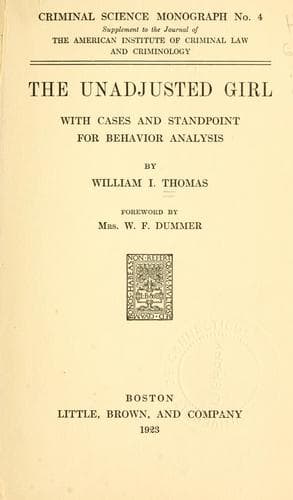
The Unadjusted Girl, With Cases and Standpoint for Behavior AnalysisThomas, William Isaac
Science
The Unadjusted Girl, With Cases and Standpoint for Behavior Analysis
Thomas, William Isaac
Female juvenile delinquents -- Case studies; Young women
In connection with this problem we may again refer to the natural and
biological sciences. These have obtained their results, the establishing
of laws, by the use of experiment. Having isolated a problem, say the
problem of heredity, they make conjectures as to what would happen under
changed conditions, and consciously introduce all changes which are
conceived as having a possible meaning for the problem. In these
sciences the experimenter is not hindered from introducing changes by
the consideration that he may spoil his materials. The chemist or
entomologist expects to spoil many materials in the course of his tests.
Human material is, however, so precious that the experimenter is not
justified in assuming the risk of spoiling it. The child is more
precious than the problem. The only field in which experiment on the
human being is recognized, or rather practiced without recognition, is
medicine, where the material is already threatened with destruction
through sickness, and the physician introduces an experimental change,
say the use of a serum, which gives a chance of preserving life and
restoring health.
Nevertheless, as the result of a series of experiments on the behavior
of animals, one of the psychologists assumed that similar work might be
done on the newborn child with no more discomfort than he suffers in
having his ears scrubbed and certainly no more damage than he receives
from the strains and distortions suffered in the act of being born. I
quote from the record of these experiments:
On the psychological side our knowledge of infant life is almost
nil.... A prominent professor of education once said to us, “You
will find when you have taught as many children as I have that you
can do nothing with a child until it is over five years of age.” Our
own view after studying many hundreds of infants is that one can
make or break the child so far as its personality is concerned long
before the age of five is reached. We believe that by the end of the
second year the pattern of the future individual is already laid
down. Many things which go into the making of this pattern are under
the control of the parents, but as yet they have not been made aware
of them. The question as to whether the child will possess a stable
or unstable personality, whether it is going to be timid and beset
with many fears and subject to rages and tantrums, whether it will
exhibit tendencies of general over or under emotionalism, and the
like, has been answered already by the end of the two year period.
Public-domain text, read in full here on John Shaqi.
Reviews
Reviews
No reviews yet
Be the first to share your thoughts on this work.
Elsewhere in the archive
Join the Discussion
Join the discussion
Sign in to leave a comment or review.
Sign InorCreate an account