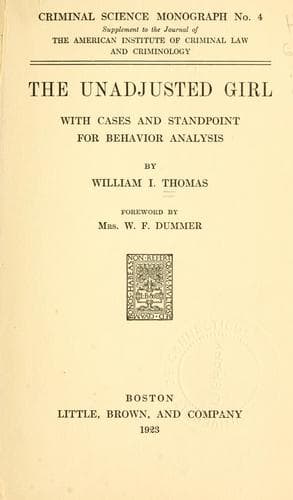
The Unadjusted Girl, With Cases and Standpoint for Behavior AnalysisThomas, William Isaac
Science
The Unadjusted Girl, With Cases and Standpoint for Behavior Analysis
Thomas, William Isaac
Female juvenile delinquents -- Case studies; Young women
The moralist complains of the materialization of men and expects a
change of the social organization to be brought about by moral or
religious preaching; the economic determinist considers the whole social
organization as conditioned fundamentally and necessarily by economic
factors and expects an improvement exclusively from a possible
historically necessary modification of the economic organization itself.
From the viewpoint of behavior the problem is much more serious and
objective than the moralist conceives it, but much less limited and
determined than it appears to the economic determinist. The economic
interests are only one class of human attitudes among others, and every
attitude can be modified by an adequate social technic. The interest in
the nature of work is frequently as strong as or stronger than the
interest in the economic results of the work, and often finds an
objective expression in spite of the fact that actual social
organization has little place for it. The protests, in fact, represented
by William Morris mean that a certain class of work has visibly passed
from the stage where it was stimulating to a stage where it is not,—that
the handicrafts formerly expressed an interest in the work itself rather
than in the economic returns from the work. Since every attitude tends
to influence social institutions, we may expect that an organization and
a division of labor based on occupational interests may gradually
replace the present organization based on demands of economic
productivity. In other words, with the appropriate change of attitudes
and values all work may become artistic work. And with the appropriate
change of attitudes and values the recognition of economic success may
be subordinated to the recognition of human values.
INDEX
Abbott, Edith, 102, 211.
Abnormality, problem of, 255.
Addams, Jane, 31.
Additon, Henrietta, 212.
Alcoholism, problem of, 255.
Anger, emotion of, 2.
Attitudes, mental, 233.
Bedford Hills Reformatory, 172.
Behavior, a science of, 228.
Bentley, Mary Ide, 86.
Bohemian, 12.
Breckenridge, S. P., 102, 211.
Cabot, Hugh, 92.
Cadet, the, 141.
Character, definition of, 241.
Charity girl, 119.
Chicago Vice Commission, 229.
Church, Irish Catholic, 159;
Polish Catholic, 159.
Code, the social, 50.
Common sense _vs._ scientific procedure, 225.
Community, 43.
Crime, problem of, 255.
Crime and punishment, 223.
Criminology, procedure of, 222.
Culbert, Jane F., 216.
Cultures, problem of, 255.
Davis, Katherine B., 116, 117, 118.
Daydreaming, 35.
Deardorff, Neva R., 212.
Delinquency, beginning of, 109.
Delinquent, proportion of foreign born, 152.
Demi-virgin, 231.
Demoralization of girls, 98, 150.
Dostoievsky, F., 10.
Economic Determination, 118.
Economic interests, overdetermination of, 256.
Economic problem, 256.
Eliot, Thomas D., 211.
Ellis, Havelock, 100.
El Retiro, 200.
Public-domain text, read in full here on John Shaqi.
Reviews
Reviews
No reviews yet
Be the first to share your thoughts on this work.
Elsewhere in the archive
Join the Discussion
Join the discussion
Sign in to leave a comment or review.
Sign InorCreate an account