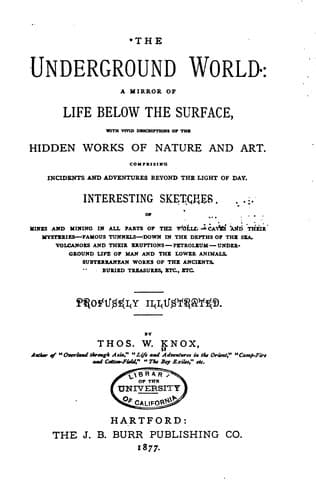
The Underground World: A mirror of life below the surfaceKnox, Thomas Wallace
History
The Underground World: A mirror of life below the surface
Knox, Thomas Wallace
Caves; Mines and mineral resources; Social history -- 19th century; Tunnels
“Yesterday morning I went out to get a carriage to go up Mount
Vesuvius, and on my way I was asked by a respectable looking man in
the street if I had heard the news of the night. He then told me
that hundreds of people, who had gone up the night before to see
the burning lava in the Atrio di Cavallo, were dead. I had seen the
mountain at eleven o’clock the night before, when there was a stream
of lava running from the top of the cone into the Atrio—that is, the
valley between Vesuvius and the adjoining hill, the Somma, where
there seemed to be a lake of fire. Later in the night there was a
tremendous eruption, a large crater opening suddenly between the
Observatory and the Atrio di Cavallo, across the path of the visitors,
it is said, of a mile in diameter. We started from Naples at eight
o’clock. The view of the mountain was magnificent. An enormous cloud
of dense white smoke was ascending to an immense height above the
mountain, like great fleeces of cotton wool, quite unlike any cloud I
ever saw. I could see the lava rushing from several openings to the
right of and above the Observatory, but below the cone. The lava was
still flowing from the cone into the Atrio, but no ash or dust was
thrown up. We drove on to Resina, where the population were in fearful
excitement, not knowing what to do, and apparently apprehensive of
instant death—everybody making signs to us, and telling us to go back.
We went on to the Piazza di Pugliano, where we were stopped and told
that no one was allowed to go up the mountain, by order of the police.
However, after some expostulation, I took a guide on the box and
started again.
[Sidenote: AN ISLAND OF FIRE.]
“A few minutes afterwards we met a cart bringing down a dead body, and
as we went on we saw other bodies—at least twelve—of which one only
appeared to be living. They were frightfully burned on the face and
hands, and some, which were carried on chairs, in a sitting position,
were very ghastly objects. Further on we met people—officials,
apparently—coming down, all warning us to go back. At last, when we
had arrived at an elbow of the road not far below the Observatory, we
met the officer who has charge of the Observatory, who said we could
not go on; that the danger was imminent; that the lava was running
across and down the road before us; that he had orders from the
prefect of Naples to prevent any one ascending, and that we could not
pass. My coachman was getting a little anxious, though I will do him
the justice to say he was not afraid; so I consented not to take the
carriage beyond a turn in the road above us to the right, especially
as I did not wish to meet the lava in a narrow road where we could not
turn the carriage. We left the carriage there, and ascended on foot
with the guide by a path straight up the mountain-side.
Public-domain text, read in full here on John Shaqi.
Reviews
Reviews
No reviews yet
Be the first to share your thoughts on this work.
Elsewhere in the archive
Join the Discussion
Join the discussion
Sign in to leave a comment or review.
Sign InorCreate an account