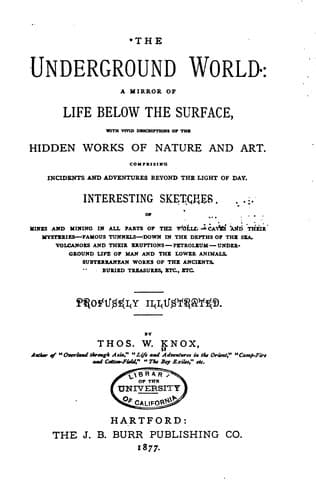
The Underground World: A mirror of life below the surfaceKnox, Thomas Wallace
History
The Underground World: A mirror of life below the surface
Knox, Thomas Wallace
Caves; Mines and mineral resources; Social history -- 19th century; Tunnels
“After stopping some time to admire the scene, we continued our
descent; but before we reached the bottom of the hill we saw the lava
from the last crater tearing its way down through the vineyards to our
right with wonderful rapidity. Just an hour after we left the top of
the hill the cone commenced sending up torrents of stones, which fell
in all directions; but whether the red-hot hail reached our position
on the height I know not. When we reached Resina it was curious to
see the congratulations for what they thought our escape on the faces
of the people. The uncertainty and the panic were gone, and they were
steadily packing up their beds and the few things they could carry,
and starting with every sort of conveyance to put their guardian
saint, St. Gennaro, between them and the danger. When I started from
Naples I expected to find all the world at the top of the mountain;
but, to my great surprise, there was not a single stranger there—only
the few persons employed in bringing down the dead. I believe the
police prevented any carriage passing after ours. The awful roaring of
the mountain continued and increased till midnight, when it ceased,
and only roared again for a short time about four o’clock. To-day the
mountain is quieter, and the Neapolitans are a trifle less pale. The
view of the mountain at midnight was grand in the extreme.”
[Sidenote: THE ERUPTION SUBSIDING.]
Several villages were destroyed in this eruption, and many acres of
vines were covered with lava and ashes. But as soon as the eruption
was over, many of those who had fled returned to whatever of their old
homes they could find. There is something strange in the fascination
of the people for the places which they are well aware are liable at
any time to the lava torrent or the storm of ashes. Eruptions have
occurred, and will occur again; but all the reasoning you can offer
would not induce these Italian peasants to go and live elsewhere.
At the present time Professor Palmieri reports from his observatory,
near the top of the crater, that symptoms have been observed by him
which indicate a new eruption, and strange to say, the Italians, who
are accustomed to live constantly in danger, quietly look out for the
occurrence, living at the very foot of the death-dealing mountain. The
soil is extremely fertile, and eagerness for wealth seems here even to
expel fear for death.
XIII.
THE CAVERNS OF NAPLES.
EXCAVATIONS NEAR NAPLES.—POZZUOLI.—VISIT TO THE CAVE OF
THE CUMEAN SIBYL.—ACCIDENT TO AN ENGLISH TRAVELLER.—HUMAN
PACK-HORSES.—DARKNESS AND TORCHES.—THE LAKE OF AVERNUS.—DROWNED
IN BOILING WATER.—A DANGEROUS WALK.—IN NERO’S PRISON.—INSTRUMENTS
OF TORTURE.—USE OF THE RACK.—THE IRON BEDSTEAD.—BROILING A MAN
ALIVE.—TREATMENT OF PRISONERS.—AN ANCIENT FUNERAL. —VIRGIL’S
TOMB.—CONSTRUCTING WINE CELLARS.—NOVEL PLAN OF ROBBERY.
Public-domain text, read in full here on John Shaqi.
Reviews
Reviews
No reviews yet
Be the first to share your thoughts on this work.
Elsewhere in the archive
Join the Discussion
Join the discussion
Sign in to leave a comment or review.
Sign InorCreate an account