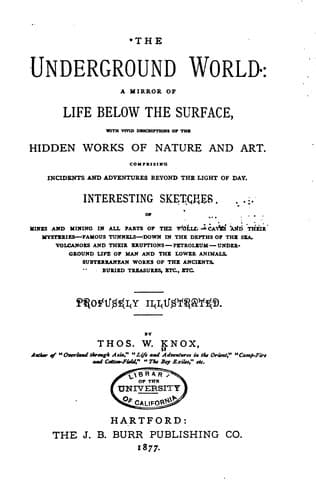
The Underground World: A mirror of life below the surfaceKnox, Thomas Wallace
History
The Underground World: A mirror of life below the surface
Knox, Thomas Wallace
Caves; Mines and mineral resources; Social history -- 19th century; Tunnels
Down in the kitchen, Nero had a gridiron resembling a garden gate,
or a section of an iron fence. He had so many cooks that all of them
could not be constantly employed, and so he busied himself to devise
ways to employ them. He found that the gridiron was just the thing,
and when his cooks were idle he used to take one of his lodgers down
stairs and promise him a good roast. The lodger would be thinking of a
nice turkey or a leg of mutton when Nero said “roast” to him, and as
the private table was not very good, he was always ready to go below.
When they got down stairs Nero would tip the wink to the cooks, who
would seize the lodger and tie him on the gridiron. They then built
a fire under him, and Nero carried on the joke by standing alongside
with a big ladle and pouring hot oil over his guest. When he was done
brown, and turned over and done on the other side, they would let him
off to enjoy the fun of seeing the sell played on the next man. No
doubt he would have enjoyed it had he not been dead long before they
got through with him.
[Sidenote: THE TOMB OF VIRGIL.]
When we returned to Naples, we went by another route than the one we
had taken in the morning. At one place our way led through a tunnel
cut into the solid earth, and said to be more than two thousand years
old. It has worn down greatly since it was first opened; the marks
of the axles of carts and wagons are visible along its sides ten or
twelve feet above the present floor. It is lighted by torches placed
at regular intervals along the walls, and is an important thoroughfare
for people going between Naples and certain villages and towns to
the north of it. At the end nearest to Naples we were taken to what
is supposed to be the Tomb of Virgil, though its authenticity is
considerably in doubt. It certainly is not much of a tomb, and many
a man not half so talented or famous as Virgil has been lodged after
death in far more beautiful quarters than these.
The peculiar nature of the earth composing the hills around Naples
has greatly facilitated the construction of tunnels and caves. It is
almost identical with that of the bluffs of Vicksburg—easy to cut, and
at the same time sufficiently firm to prevent falling in. No roofing
or arching of any kind is needed, and the tools ordinarily used in
excavations are all that are required. Consequently every man who has
a hill on his farm can construct a spacious wine cellar at little
expense; and if he has a friendly neighbor over the hill, they can
easily cut their way through, and save the trouble of climbing when
they want to visit each other.
I heard of Neapolitan thieves who sometimes find out a well-stored
wine cellar in the side of a small hill, and carefully observe its
position. Then they erect a small house on the other side, and begin a
small tunnel. They cart the dirt away at night, and after a month or
so enter the cellar and steal enough wine to pay them handsomely for
their trouble.
XIV.
Public-domain text, read in full here on John Shaqi.
Reviews
Reviews
No reviews yet
Be the first to share your thoughts on this work.
Elsewhere in the archive
Join the Discussion
Join the discussion
Sign in to leave a comment or review.
Sign InorCreate an account