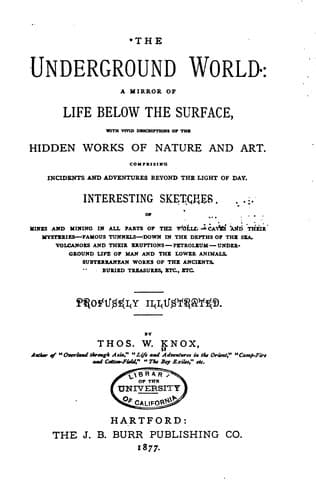
The Underground World: A mirror of life below the surfaceKnox, Thomas Wallace
History
The Underground World: A mirror of life below the surface
Knox, Thomas Wallace
Caves; Mines and mineral resources; Social history -- 19th century; Tunnels
“Here, after having examined the ruin, we lunched and again mounting
our horses, proceeded to view the celebrated ‘Lions’ of Mycenæ, once
the site of the royal palace of Agamemnon—itself a _ruin in the time
of Homer_—its foundation going back to an almost dateless antiquity.
The ruins of Mycenæ are, in many respects, unequaled in interest
by any object in Greece. Their position is fortunate; there is no
habitation near them. The traveler ascends from the open plain to the
deserted hill on which they stand. The walls of the citadel may still
be traced in their entire circuit, and on the western side they rise
to a considerable height. Only a few foundations of ancient buildings
remain, and one or two cisterns hewn in the rocky soil, and lined with
cement. Such is the present state of the Acropolis of Mycenæ. Two
gates, one on the northeast, the other on the northwest, both guarded
by a tower, gave entrance into the city. The two gates and tower seem
to have been connected, and illustrate the military architecture
presented to our notice in the Iliad. The ‘Lions’ are represented in
high relief, rampant, headless, their feet resting on a pedestal which
is a Doric column reversed, carved out of a block of gray limestone.
By whom erected, or for what purpose, must ever remain a mystery.
Perhaps the simplest explanation is the best, that they denote
the ‘courage leonine,’ and were heraldic badges upon the national
escutcheon of Mycenæ. We clambered over the walls of the ruined
palace of Agamemnon, on the hill-side we came across several pieces
of antique pottery, which we have preserved. To make the illusion
more complete, while we were exploring the ruins, a fierce, wolfish,
shepherd-dog, the only guardian of the place, in a field below, kept
up a loud, persistent barking, which ceased not till we had left the
spot.”
It is perhaps too soon, in the present imperfect state of the
excavations at Mycenæ, to form a true estimate of their value, as
related to the authenticity of the heroes of Homer. However, we will
give, as far as that is possible, from the reports of Dr. Schliemann
himself, a review of the wonderful things which this great sapper and
miner has brought to light:
[Sidenote: THE CITY OF MYCENÆ.]
The city of Mycenæ must have been wonderfully beautiful. Homer calls
it “the city rich in gold and broad of streets,” at the time when
the ruler of Mycenæ, Agamemnon, assisted the Greeks against Troja,
with one hundred ships, and a great number of men, for which service
he was elected their commander-in-chief. He fell, at his return, by
the faithlessness of his wife, and with him the glory of the city
was gone. Only rarely we find, in history, traces of her unimportant
existence. About the middle of the fifth century B. C., she was
destroyed by the Argivi, and her inhabitants dispersed.
[Illustration: THE EXPLORATIONS AT MYCENÆ. THE TREASURY OF ATREUS
(ENTRANCE.)]
Public-domain text, read in full here on John Shaqi.
Reviews
Reviews
No reviews yet
Be the first to share your thoughts on this work.
Elsewhere in the archive
Join the Discussion
Join the discussion
Sign in to leave a comment or review.
Sign InorCreate an account