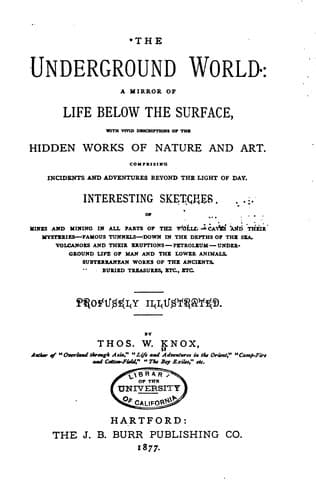
The Underground World: A mirror of life below the surfaceKnox, Thomas Wallace
History
The Underground World: A mirror of life below the surface
Knox, Thomas Wallace
Caves; Mines and mineral resources; Social history -- 19th century; Tunnels
One of the foremost silver-producing countries in the world is Mexico,
and its fame extends a long distance into the past. The metal was
known to the ancient Aztecs, and was worked by them, with exquisite
skill, into numerous ornamental and useful articles, but among the
vast mineral treasures of Montezuma, the quantity of silver was
small compared with that of gold, and gave little promise of the
argentiferous mines of his territories.
[Sidenote: THE SPANISH MINERS.]
The Spaniards had a keen eye for valuable things, and no sooner did
they find what the country contained in mineral wealth, than they
proceeded at once to develop it.
They opened mines wherever there were indications of silver, and so
fast did they progress that it was estimated, at the beginning of
this century, that operations were going on in from four thousand to
five thousand localities, which might all be included in about three
thousand distinct mines. These were scattered along the range of the
Cordilleras in eight groups, the principal of which, known as the
central group, contains the famous mining districts of Guanajuato,
Catoree, Zacatecas, and Sombrerete, and furnished more than half of
all the silver produced in Mexico.
The great vein, or _Veta Madre_, is referred to elsewhere, and is
one of the most remarkable deposits anywhere known. It is contained
chiefly in clay slate, and crosses the southern slope of the hills
in a northwest and southeast direction, dipping with the slates (the
range which it follows) from forty-five to forty eight degrees toward
the southwest. The width averages a hundred and fifty feet, and the
depth is unknown. It has been traced about twelve miles, but its most
productive portion thus far, or rather, the portion operated, is only
about a tenth of that distance.
The mines of Zacatecas, opened in 1548, are also upon a single vein,
called the Veta Grande, averaging in thickness about thirty feet.
The formation is of green stone and clay slate, the former the most
productive. The veins of Catoree are in limestone, supposed to be of
carboniferous age.
[Sidenote: THE ORE IN THE MINES.]
The greatest proportion of silver in every mining district of
Mexico is obtained from the sulphuret of silver, an ore of gray
color, disseminated through the quartz matrix in minute particles,
and more or less combined with other metals. The other varieties
of argentiferous ores are numerous, but comparatively small in
quantity; they are the chloride of silver, ruby silver, native silver,
argentiferous pyrites, and argentiferous galena.
Public-domain text, read in full here on John Shaqi.
Reviews
Reviews
No reviews yet
Be the first to share your thoughts on this work.
Elsewhere in the archive
Join the Discussion
Join the discussion
Sign in to leave a comment or review.
Sign InorCreate an account