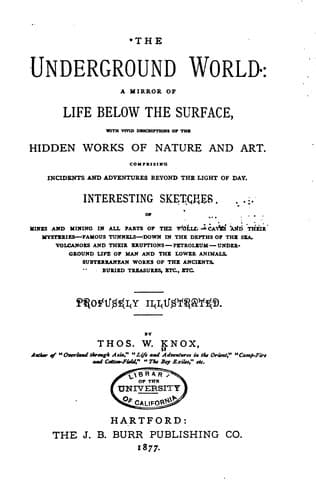
The Underground World: A mirror of life below the surfaceKnox, Thomas Wallace
History
The Underground World: A mirror of life below the surface
Knox, Thomas Wallace
Caves; Mines and mineral resources; Social history -- 19th century; Tunnels
But this was nothing to what followed; balls of the fiber of the
maguey, or aloe plant, three feet in diameter, and steeped in pine
pitch or resin, were swung out over the mouth of the shaft, and
set on fire. When the first was in full blaze, it was detached, and
allowed to fall into the abyss. Like a great comet with body of molten
metal, and long tail of flame, rushing on a doomed planet, the monster
projectile came down from the dizzy height above us, and passing the
mouth of the tunnel in which we stood, with a roar more deafening than
the loudest thunder, went bounding and crashing into the depths below,
illuminating everything, for a moment, with the blinding, lurid glare,
followed by a darkness and silence more profound than before. As soon
as the tremendous echoes which were awakened by the first, had died
away, a second was sent down, and others followed in quick succession.
Most of our party were unable to control their nerves sufficiently
to enable them to approach the edge and look up and down the tiro,
holding by ropes to prevent them from becoming dizzy and falling
headlong into the depths, but those who could do so, beheld a scene,
the awful sublimity and grandeur of which beggars all the powers of
language.
[Sidenote: DOWN TO THE BOTTOM OF THE MINE.]
The remainder of the party now left, and I, in company with the
superintendent, clothing myself in a miner’s suit, to keep off the
water and mud, descended to the bottom of the mine, one thousand feet
and more from the surface.
We went down ladder after ladder, along gallery after gallery, through
chambers like great churches in size, and others in which we could
not stand erect, down steps cut in the rock, and so slippery with
dripping water and soft clay, as to compel us to use an iron-shod
staff to support ourselves, and through many a winding turning, until
we stood at the bottom of the tiro, wet through with perspiration, and
trembling with exhaustion.
At the bottom of the tiro is a great pond of water, the reservoir into
which all the drainings of the mine are gathered, and the buckets
on the great cables, worked by the _malacates_ at the top, were
constantly coming and going between it and the end of the tunnel six
hundred feet above. These buckets will hold three to four hogsheads of
water, and are made of rawhide, in the form of an ordinary Mexican
water jar. An iron ring distends the mouth of the bucket, and when
the vessel descends, the wet hide flattening down allows the water to
rush in, and as the lifting commences, it falls back into its original
form, filled to the brim with the dirty fluid. When the bucket reaches
the level of the tunnel, it is hauled into the opening, and as the
cable is slackened up, it flattens down again, and the water, escaping
over the rim, runs off down the side of the tunnel.
Public-domain text, read in full here on John Shaqi.
Reviews
Reviews
No reviews yet
Be the first to share your thoughts on this work.
Elsewhere in the archive
Join the Discussion
Join the discussion
Sign in to leave a comment or review.
Sign InorCreate an account