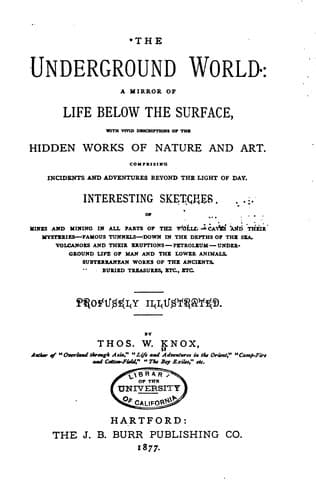
The Underground World: A mirror of life below the surfaceKnox, Thomas Wallace
History
The Underground World: A mirror of life below the surface
Knox, Thomas Wallace
Caves; Mines and mineral resources; Social history -- 19th century; Tunnels
One might imagine that the diamonds and many of the other valuables of
the Green Vaults would be in danger from the admission of strangers.
The naturalness of this opinion has doubtless given rise to the story
that unseen soldiers have their muskets levelled through invisible
loopholes in the walls at the head or breast of everybody entering the
royal treasury. This is a mere romance, never having had the smallest
foundation in fact. Such precautions are not at all necessary; for
nobody could steal anything, and get away with it, even if he should
try. The costliest objects are covered with strong iron or steel
wires, not sufficient to obstruct the view, bµt enough to prevent
their seizure by any designing or dishonest person. Moreover, the
custodian, who conducts you through the cabinets, locks and bolts each
door after him, so that the thief could not easily make his escape;
and if he did succeed in getting beyond the walls, an alarm would be
immediately given, which would almost necessarily insure his capture.
The value of the entire collection at Dresden it is almost impossible
to give. I have heard it estimated at from twenty millions to
twenty-five millions of dollars, and even as high as fifty millions.
Most of the works of art, as well as the jewels, are actually beyond
price; for they could not be replaced. They could not be purchased
any more than the Raffaelles, Correggios, and Titians, in the famous
Picture Gallery in the same city.
It is said that numerous efforts have been made during the past
hundred years to rob the Green Vaults.
One of these was by two Poles, who had had a wide experience in
forgery, burglary, and crimes of all sorts, in the early part of the
present century. They had at first designed to secure a number of
confederates, but afterwards abandoned the idea, fearing that their
secret would be unsafe when so many persons shared it. After revolving
various plans in their mind, they concluded to depend upon themselves
alone, and accordingly entered the vaults, pretending to be Protestant
clergymen from Geneva, in company with a large party of visitors,
composed mostly of Englishmen and Americans. When they had reached the
last cabinet, and while one of them was making particular inquiries of
the custodian, and attracting the attention of the party by his large
fund of information (he spoke English with remarkable facility), his
companion contrived to hide himself in something closely resembling
a bale, the material for which he had concealed upon his person. A
quarter of an hour after, one of the supposed-to-be clergymen was
missed, and his disappearance was explained by the positive statement
of his confederate that he had returned to his hotel while they
were in the third apartment, having an engagement that demanded his
presence. A number of the visitors thought they had seen him a
few minutes before; but the disguised Pole was so positive in his
declaration, that they naturally fancied themselves mistaken.
Public-domain text, read in full here on John Shaqi.
Reviews
Reviews
No reviews yet
Be the first to share your thoughts on this work.
Elsewhere in the archive
Join the Discussion
Join the discussion
Sign in to leave a comment or review.
Sign InorCreate an account