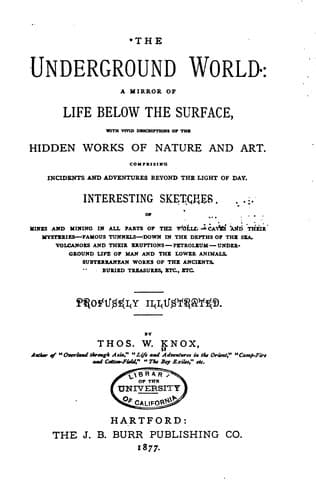
The Underground World: A mirror of life below the surfaceKnox, Thomas Wallace
History
The Underground World: A mirror of life below the surface
Knox, Thomas Wallace
Caves; Mines and mineral resources; Social history -- 19th century; Tunnels
About fifty years ago, as the story is told in Dresden, certain
changes were made in the Green Vaults, involving the laying of a
new interior wall of brick. This intended addition having become
generally known, an enterprising rogue in the city conceived a plan
of robbing the treasury by concealing himself in a part of the wall
then unfinished; designing to get out at night, after the workmen had
gone away, and carry off whatever was lightest and of most value. He
did succeed in concealing himself, as he had wished; but unfortunately
for him, the masons worked more rapidly than he had supposed they
would, and enclosed him completely. Whether he knew at the time what
would happen, and was afraid of revealing his presence, or whether
he was totally ignorant of the peril of his situation, will forever
remain unknown. As may be imagined, the thief, being, like other
mortals, unable to live without air, soon succumbed to his peculiar
surroundings, though his fate was a secret for years after.
New improvements, then making, caused the removal of the brick wall,
and within it the perfect skeleton of a man was discovered. Great and
exciting was the mystery at first; but diligent inquiry, and vivid
recalling of the date when the work was done, solved the enigma by
establishing a connection between the finding of the skeleton and
the disappearance of a certain notorious criminal. The skeleton of
the thief was put together, and for some time occupied a conspicuous
position in the vaults, as a warning to all inclined to follow his
example. But it served as an example instead, as was shown by the
fact that several attempts at robbery were made there within six
months after the grim exposure. The skeleton was then removed from
the vaults, and as is popularly supposed, has been transferred in a
multiplied form to the private closets of the Dresdeners.
Not a great while ago, a story was started to the effect that the
principal diamonds in the Green Vaults had been stolen by some of the
officials of the court, and replaced with counterfeit stones. This
report obtained wide currency, and was generally believed among the
common people. It may be inferred that there was no basis whatever for
the tale, as any one who is a judge of jewels may easily determine
for himself. If it were possible to make such excellent counterfeits
of diamonds as are those now at Dresden, genuine gems would certainly
lose much of their value, since there would be no method of
distinguishing between the real and spurious.
Public-domain text, read in full here on John Shaqi.
Reviews
Reviews
No reviews yet
Be the first to share your thoughts on this work.
Elsewhere in the archive
Join the Discussion
Join the discussion
Sign in to leave a comment or review.
Sign InorCreate an account