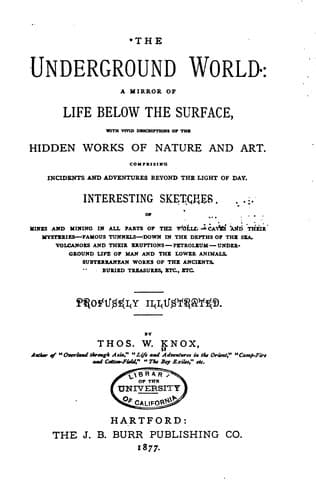
The Underground World: A mirror of life below the surfaceKnox, Thomas Wallace
History
The Underground World: A mirror of life below the surface
Knox, Thomas Wallace
Caves; Mines and mineral resources; Social history -- 19th century; Tunnels
Still, I was not deceived. There _was_ a light before me, and as I
dashed on involuntarily, I saw that it proceeded from the tapers of my
companions, whom I had nearly overtaken. The reaction of my feelings
almost prostrated me. My heart beat like a tilt hammer, my breath was
well nigh spent, my pulses leaped with fever, and yet I felt that my
face must be blanched, and I should not have been surprised if my hair
had turned gray.
In a few seconds I had joined my party and relighted my taper. Nobody
knew through what a crisis I had passed, nor did I say anything about
it except to remark, casually, that I had extinguished my candle by
letting it fall. From inquiries I learned that from the moment I had
missed my companions until I had rejoined them, not more than two
minutes had elapsed; and still, by the measure of my mind, I had lived
through months of pain.
If I had not already known it, I should have been convinced then that
time can be reckoned only by feeling; that no clock can keep the
record of the heart; and that the soul strikes hours every moment of
its existence.
[Sidenote: ADVICE TO EXPLORERS.]
I would advise those who may feel inclined to go through the Catacombs
to take a box of wax matches in their pocket, and a little luncheon
besides, so that if their taper be blown out, or they be lost, they
may at least be relieved from the terror of absolute darkness and
immediate starvation. When persons are missed down there, a search is
immediately made for them, and nobody would feel half so uncomfortable
while he had light and food as he would in the midst of gloom, and
haunted by the necessity of dining on himself.
The moist and grave-like odor which fills the Catacombs, added to the
images of death on every side, intensifies their sepulchral aspect,
and makes those wandering in the ghastly haunts seem to themselves
only half alive. The faces of those with me did not appear any
more natural than their voices, and all of us had a certain taint
of the tomb. Even the tapers flickered and sank in the unwholesome
atmosphere, as though even fire, which rages in the centre of the
earth, could not support itself in that dusky Golgotha.
In some places the skulls have been arranged in the form of crosses
and set into the wall—probably by the priests of Paris, who, like
all their tribe, delight in symbols and devices coupling death and
religion; forgetting that the creed they preach declares there is no
death, that true religion leads to eternal life. Monks of all ages—and
there are many monks who have never taken orders—have been little more
than sacerdotal sextons, revelling in disease and decay, lamentation
and funerals, as if Nature had set their spirits to the music of
bereavement and woe.
Public-domain text, read in full here on John Shaqi.
Reviews
Reviews
No reviews yet
Be the first to share your thoughts on this work.
Elsewhere in the archive
Join the Discussion
Join the discussion
Sign in to leave a comment or review.
Sign InorCreate an account