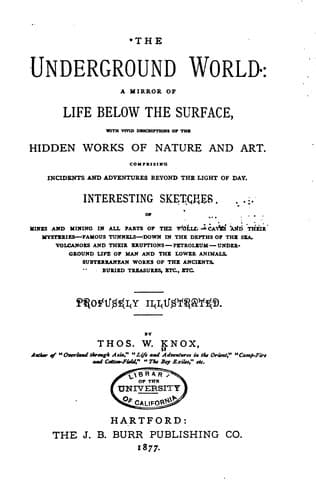
The Underground World: A mirror of life below the surfaceKnox, Thomas Wallace
History
The Underground World: A mirror of life below the surface
Knox, Thomas Wallace
Caves; Mines and mineral resources; Social history -- 19th century; Tunnels
No doubt there is a great deal of truth in these maxims; but in spite
of them, and many more like them, death has never been rendered
very attractive to persons enjoying good health and a fair degree
of prosperity. Death bears about the same relation to life that
the Catacombs do to Paris; and I have never yet known any man or
woman who would willingly quit the gay Boulevards or the delightful
Champs Elysées to walk in the bone-lined and noisome vaults of the
subterranean city.
We passed only through the main avenues of the Catacombs,—there is
very little variety in them,—and after spending nearly three hours
underground, having supped full of material horrors, we reached
another staircase, and once more ascended to the light of day, and the
blessed sunshine. I had no idea where we were, and I was somewhat
surprised to find that we came out nearly a mile and a half from where
we had gone down. The charming capital never, I think, appeared quite
so charming as it did on that delicious afternoon when I returned from
death and decay to the living and the loving, to the comforts and the
joys, of the upper world.
[Sidenote: AN ENGLISHMAN’S OPINIONS.]
While we were in that vast subterranean graveyard, I was struck by
the different effect it produced upon different persons in our party.
An Englishman, who was extremely anxious to “do the thing, you know,”
was superlatively disgusted after he had passed the vestibule, and
declared the Catacombs the “beastliest place” he had ever seen. He
grumbled like Vesuvius before eruption, and swore that the French
authorities ought to be exposed for permitting the subjects of Her
Majesty to thrust themselves into such a “bloody” hole. He even
suggested that it was a French trick to get rid of certain true and
noble Britons, and, of course, threatened to write to the Times on the
subject. He was constantly predicting that the rock overhead would
tumble down and bury us all, and really seemed uncomfortable because
something horrible did not happen. After he had gone half way through,
he wanted to go back, and when he had reached the end of the route,
he was much dissatisfied that we hadn’t done a great deal more. He
fretted and fumed every minute of the three hours, and did his best to
render every one as nervous and discontented as himself.
Public-domain text, read in full here on John Shaqi.
Reviews
Reviews
No reviews yet
Be the first to share your thoughts on this work.
Elsewhere in the archive
Join the Discussion
Join the discussion
Sign in to leave a comment or review.
Sign InorCreate an account