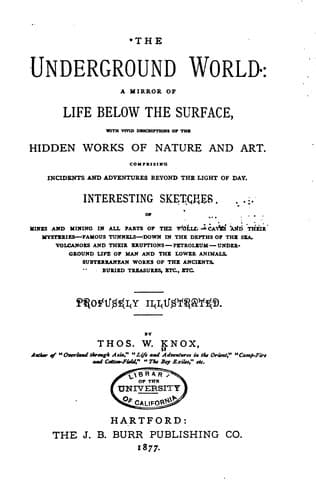
The Underground World: A mirror of life below the surfaceKnox, Thomas Wallace
History
The Underground World: A mirror of life below the surface
Knox, Thomas Wallace
Caves; Mines and mineral resources; Social history -- 19th century; Tunnels
WINE CELLARS.—HOW THEY ARE MADE.—PLACES FOR STORING
BEER.—THEIR EXTENT.—THE GREATEST WINE CASK IN THE WORLD.—ITS
CAPACITY.—PECULIARITIES OF WINE AND BEER VAULTS.—VISITING A CELLAR
IN POLAND.—CURIOUS SIGHTS.—THE ANTIQUITY OF THE BOTTLES.—WHAT A
VISITOR DID.—THE RESULT OF TOO MUCH WINE.—A DANGEROUS BRIDGE.
A German resident of New York, engaged in the manufacture of beer,
visited the excavations at Hallett’s Point, near the upper end of
Manhattan Island, and, on viewing the large space which had been dug
out of the solid rock, exclaimed, “What a capital place for storing
lager beer.” Many a wine and beer manufacturer has made the same
remark on visiting the Mammoth Cave, or other huge caverns. The best
places for storing malt or vinous liquors are under ground, for the
reason that an equal temperature can be maintained at all times;
summer’s heat and winter’s cold make but very little change of the
thermometer in the depths of the earth.
[Sidenote: PLACES FOR WINE UNDER GROUND.]
In various parts of the world, particularly in Europe, there are vast
underground spaces specially designed for the storage of wine, beer,
and similar beverages. Nearly all these articles require to be kept
some time before they are fit for use; especially is this the case
with wines, some of which improve steadily during a year, or for ten,
or twenty, fifty, or it may be for a hundred, or five hundred years.
Some of the wine cellars of Europe have been hewn out of the solid
rock, or dug out of the solid earth, at vast expense, for the simple
purpose of storage. Other wine cellars were, originally, quarries,
or mines; and after they had been abandoned by the miners, they were
taken up by the wine and beer manufacturers, and adapted to their
present uses. The same is the case in America. Reference is made
elsewhere to the cellars of Dubuque, Iowa, which are nothing more nor
less than exhausted lead mines. At several places on the Mississippi
and Missouri Rivers there are cellars which originally were quarries
or mines. Their natural treasures were taken from them, and they are
now filled with artificial ones.
In California, particularly in the Sonoma Valley, are some wine
cellars which have been dug out of the rock for no other purpose
than for that of storage. Some years ago I visited one of these
establishments with a small party, and the proprietor, in order to
give us an idea of the temperature, shut us up a little while, and
left us to ourselves. The place was not cold, but it was cool compared
with the outer atmosphere, and we very soon began to sneeze. Had we
been kept there for any length of time, I suspect that we would have
had sore throats and all that sort of thing; but they were prevented
by the select assortment of liquids which the wine manufacturer
supplied to us with such liberality that some of his visitors’ legs
became very much entangled, and refused to perform the duty usually
required of them.
Public-domain text, read in full here on John Shaqi.
Reviews
Reviews
No reviews yet
Be the first to share your thoughts on this work.
Elsewhere in the archive
Join the Discussion
Join the discussion
Sign in to leave a comment or review.
Sign InorCreate an account