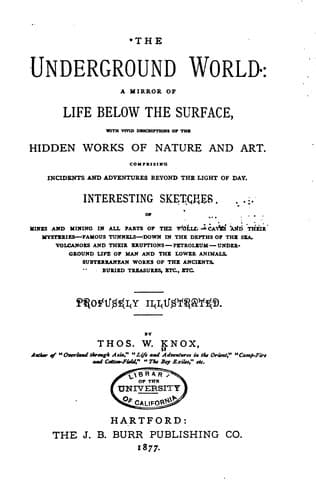
The Underground World: A mirror of life below the surfaceKnox, Thomas Wallace
History
The Underground World: A mirror of life below the surface
Knox, Thomas Wallace
Caves; Mines and mineral resources; Social history -- 19th century; Tunnels
Our guide explained that the cellar we had just visited was a modern
one, only two hundred and sixty years old. The old cellar, he said,
was made in the days when Poland was a kingdom, and more powerful by
far than the now great Muscovite empire. I do not remember positively
the age he gave it, but I think it was some nine hundred or a thousand
years old. I was too busy looking among the bottles to take particular
notice of what he said, and am not willing to trust too much to my
memory, especially on the occasion of visiting a cellar like this. The
real interest of the place began when we entered the locality where
the bottles were stored. Here were little shelves—I say little, though
many of them were three or four feet wide—covered with bottles, some
standing upright, while others were carefully packed away. There was
one shelf where the bottles had been lying undisturbed for twenty
years; another where they had not been touched for thirty, another
for forty, and another for fifty years. Above most of the shelves
a date was chiselled into the rock, and the date, as I was told,
indicated the time when the wine was bottled and placed there. These
chiselled places were, however, comparatively few, as the most common
designation was that of a date cut in a small piece of board which
rested above the bottles.
[Sidenote: OLD BOTTLES OF WINE.]
In some places the dust of ages had almost obliterated the dates,
but our guide seemed to know them all from recollection. I remember
one date of 1750, another of 1634, and I believe there was one board
dated somewhere about 1590. Shelves were pointed out which were said
to contain wine that had not been moved or disturbed in any way for
three hundred years. I do not vouch for the truth of the statement,
but merely give it as I heard it.
It was interesting to observe how the dust and cobwebs had gathered
about the bottles, and also to observe the shapes of the bottles. The
more recent shapes were those familiar to all drinkers and friends of
drinkers of the present day. Then there were short, thick-set bottles,
while others were dumpy and very long in the neck, reminding one of
an overfed goose or a camel suffering with the dropsy. Some of the
earlier bottles indicated that the art of blowing glass was not well
known at the time of their construction, as they were badly shaped,
and frequently had deep indentations in their sides. Some of them
could be called flasks, rather than bottles, as they had no necks at
all, and were round at both ends. All the bottles that I examined
were carefully sealed, and I was shown several bottles with long,
tapering necks, that had been tightly closed by melting their ends
in a flame after the wine had been placed inside, just as the tube
of a thermometer is closed after it has been filled with quicksilver
or alcohol. In order to get at the wine enclosed in this way, it is
necessary to break away the top of the neck.
[Sidenote: ONE HUNDRED DOLLARS A BOTTLE.]
Public-domain text, read in full here on John Shaqi.
Reviews
Reviews
No reviews yet
Be the first to share your thoughts on this work.
Elsewhere in the archive
Join the Discussion
Join the discussion
Sign in to leave a comment or review.
Sign InorCreate an account