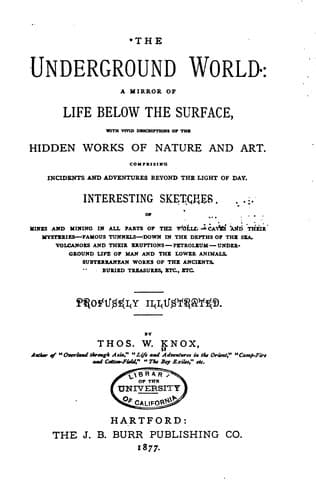
The Underground World: A mirror of life below the surfaceKnox, Thomas Wallace
History
The Underground World: A mirror of life below the surface
Knox, Thomas Wallace
Caves; Mines and mineral resources; Social history -- 19th century; Tunnels
The earth which has been gathered up for washing, if it is not worked
immediately, is placed under a long shed, and when the rainy season
begins, and water becomes abundant, the slaves are assembled for their
duty. In the diamond district of Brazil the sheds are generally about
thirty yards long, and half as wide. They consist simply of upright
posts, and a thatched roof, erected over the spot where the heaps of
gravel are placed. A stream of water is conducted through this shed.
There is a range of sloping troughs, each about three feet wide,
connecting with the streams at the upper end. Opposite the troughs
there are high chairs, where the overseers are stationed.
A slave at each trough takes about a bushel or so of the gravel, and
lets the water in slowly, in order to wash away the gravel and earthy
particles. Then he throws out the largest stones, and examines the
rest, with great care, for diamonds. Whenever he finds one, he stands
upright, clasps his hands, holding the stone between his thumb and
finger, and shows it to the overseer, who receives it.
When a slave finds a stone exceeding seventeen and a half carats
in weight, he is immediately set at liberty. Free papers are given
him, and he cannot again be enslaved. Generally, on such occasions,
a holiday or half-holiday is granted to the negroes about the
establishment. The lucky finder is carried on the shoulders of his
comrades, and when the day ends most of them are in a condition the
reverse of sober.
[Sidenote: DISCOVERY IN BRAZIL.]
In the diamond district of Brazil the diamonds were first discovered
by gold miners, about the year 1730. At first they were ignorant of
the value of the gems, and threw them away as useless. Some of the
stones were sent to the governor of Brazil as curiosities. He supposed
that they were crystals, and by accident a few were carried to Lisbon,
where they happened to be shown to the Dutch consul. The consul was
a diamond sharp, and recognized the true character of the stones. He
immediately caused them to be sent to Holland, where they were cut,
and found to be of great value.
As soon as the character of the stone became generally known, large
quantities of them were gathered and sent from Brazil, and at one time
it seemed as if the diamond market would be ruined. The Portuguese
government took means to secure a monopoly of the trade. The diamond
district was surrounded by well-defined boundaries, which were guarded
with the greatest care. No one was permitted to cross them without a
permit from the superintendent of the mine, and whenever a traveller
who had visited the diamond ground was leaving it, he was obliged to
submit to a thorough examination of himself and baggage. So great
was the vigilance, that, it is said, at one time every traveller
leaving the district was detained three days at the boundary, and
was compelled to swallow medicines whose effect was to prevent his
absconding with any precious stones concealed in his stomach.
Public-domain text, read in full here on John Shaqi.
Reviews
Reviews
No reviews yet
Be the first to share your thoughts on this work.
Elsewhere in the archive
Join the Discussion
Join the discussion
Sign in to leave a comment or review.
Sign InorCreate an account