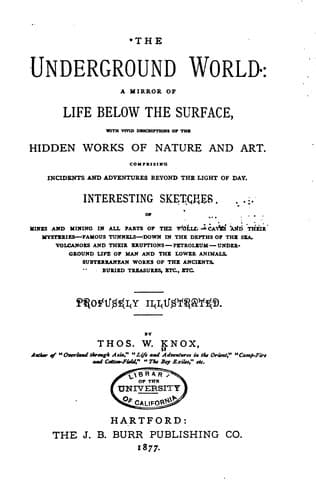
The Underground World: A mirror of life below the surfaceKnox, Thomas Wallace
History
The Underground World: A mirror of life below the surface
Knox, Thomas Wallace
Caves; Mines and mineral resources; Social history -- 19th century; Tunnels
[Sidenote: A FORTUNATE ACTOR.]
Some years ago an actor, looking through an old clothes shop in
London, found a pair of slippers decorated with glass beads, and
suited to a character he was about to play. He bought them for a
trifle, paying two or three shillings for them. He wore them on the
evening of his performance, and used to leave them lying carelessly
about the theatre. He had them a year or more before discovering, as
he did, by accident, that the supposed beads were diamonds, and that
the shoes which had cost him a few shillings were worth thousands of
pounds. He sold them soon after making the discovery, and retired upon
the fortune so easily obtained. He never took the trouble to ascertain
their previous character or history.
About twenty years ago, in a gaming-house in New York, a gambler, who
may be called Smith, put up a ring as a stake, against an outside
player for a hundred dollars. The player—I call him Jones for sake of
convenience,—won the ring and went away with it. Smith had received
the ring a short time before as a present, and was told at the time
that it was false, or, as it is generally called, “paste.” Jones took
the ring next day to a jeweller, and asked what it was.
The jeweller said, “It is paste—worth about two dollars.”
“Have you a genuine stone like it?” Jones asked of the jeweller.
“Yes,” was the reply, “I have one exactly resembling it, worth five
hundred dollars.”
“Will you take out the paste and set the genuine stone in its place,”
asked Jones, “provided I leave you its value as security, and pay you
for the use of it?”
“Certainly,” was the reply; and the bargain was quickly settled. The
change was made, and Jones walked away with the ring.
[Sidenote: HOW A GAMBLER WAS CAUGHT.]
That evening he was in the same gaming-house, and was chaffed by
the friends of Smith on obtaining a paste ring against a stake of
a hundred dollars. Jones insisted that the ring was genuine, and
offered to back his opinion with a bet of a hundred dollars. The
bet was taken, and it was agreed that Jones, Smith, and a person
selected by the two, should go together to the prominent jewellers and
ascertain the value of the ring.
Next day they visited the stores, and jeweller after jeweller examined
the stone, and pronounced it genuine, and worth four or five hundred
dollars. Most of them were ready to give four hundred dollars for it.
The bet was paid, and Jones departed to drive with a friend up town;
but on his way he called at the jeweller’s, exchanged the genuine
stone for the paste, obtained his five hundred dollars he had left on
deposit, paid for the use of the diamond, and slipped away.
That evening he was again at the gambling-house, and rallied Smith on
having sold himself. Smith acknowledged that he had been deceived, but
he never supposed the ring was worth anything, and was surprised to
find that the stone was genuine.
Public-domain text, read in full here on John Shaqi.
Reviews
Reviews
No reviews yet
Be the first to share your thoughts on this work.
Elsewhere in the archive
Join the Discussion
Join the discussion
Sign in to leave a comment or review.
Sign InorCreate an account