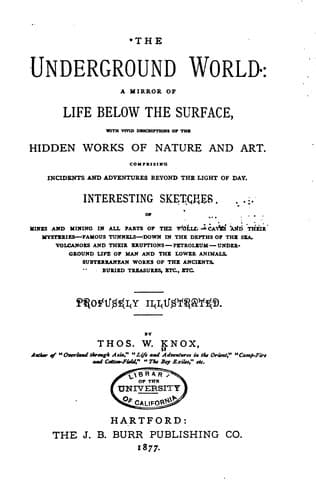
The Underground World: A mirror of life below the surfaceKnox, Thomas Wallace
History
The Underground World: A mirror of life below the surface
Knox, Thomas Wallace
Caves; Mines and mineral resources; Social history -- 19th century; Tunnels
The diamond fields of South Africa, covering an area of perhaps one
thousand square miles, are between longitude 24° and 28° east, and
latitude 27° and 30° south. It is estimated that, down to the end
of 1876, eighty-five million dollars worth of diamonds had been
taken out, and this estimate does not include thousands of stones
that were carried directly to England by their owners, and did not
pass through the market at Cape Town. Diamond owners would have been
ruined completely by the African discoveries, had it not been for the
fact that the great majority of the diamonds found there are of poor
quality. Professor Lenant, who has given considerable attention to
the matter, says that of the Cape diamonds, about ten per cent. may
be classified as first quality, fifteen per cent. of the second, and
twenty-five per cent. of the third. The remainder, under the name
of “bort,” is employed in cutting diamonds and for various other
purposes, by the lapidary, by the engineer in rock drills, for cutting
glass, and similar purposes.
[Sidenote: DIFFICULTIES OF MINING.]
Unfortunately for the miners at the Cape, there is a very short supply
of water. If they could have adopted the system of hydraulic mining to
their work, they would have saved enormous labor and expense. At many
of the fields which are distant from the rivers, the gravel is removed
by means of buckets, drawn up by long ropes, and it very often happens
that a single heavy rain of a few hours, will destroy the entire labor
of months, the pit becomes filled with water, and there will be no way
of extracting it except by evaporation, or by the laborious process of
hoisting or pumping. One of the fields, known as Colesberg Kopje, fell
off, in one year, more than fifty per cent. from the yield of previous
years, in consequence of the heavy caving and floodings caused by the
rains. The value of claims in that region has gradually fallen, and so
desperate is the condition that, at last accounts, money was loaned
upon mining licenses at the rate of ten per cent. a month, with a
foreclosure at the end of the first month if the interest was not paid.
At the diamond camp, the small stones form the basis of value.
They might be used for currency except for one fact. Gold dust, in
California, was used for currency, for a long time. Its value, of
course, is directly proportioned to its weight, a pound nugget being
worth exactly twelve times as much as an ounce nugget of the same
fineness, but the value of diamonds increases with enormous rapidity
as they grow heavier, so they cannot be put in bunch or weighed out
the same as gold. Transactions frequently take place in diamonds, and
the amount of exchange is often very difficult to compute.
Public-domain text, read in full here on John Shaqi.
Reviews
Reviews
No reviews yet
Be the first to share your thoughts on this work.
Elsewhere in the archive
Join the Discussion
Join the discussion
Sign in to leave a comment or review.
Sign InorCreate an account