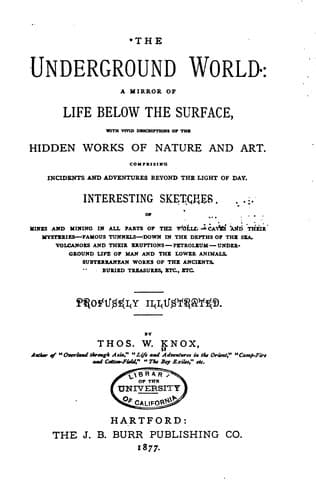
The Underground World: A mirror of life below the surfaceKnox, Thomas Wallace
History
The Underground World: A mirror of life below the surface
Knox, Thomas Wallace
Caves; Mines and mineral resources; Social history -- 19th century; Tunnels
In the early days at the diamond mines, there was a good deal of
rioting and trouble. There was not much observance of law, mainly
for the reason that there was no law. But at present, every thing
is orderly and peaceable. The diamond fields are partly in regions
controlled by the British government, and partly in the Republic
of the Orange Free States. The latter country became known to many
Americans through the Centennial Exhibition at Philadelphia, in
1876. It had a small display, but a very attractive one. First and
foremost, of course, were the diamonds in the rough, which included
many specimens of stones, varying in color and size. Then came a
quantity of the soil in which the gems are found, and then the pebbles
which accompany the diamonds. Copper, iron, and other ores were
exhibited; many excellent specimens of leather were displayed; there
was a collection of stuffed birds; there were tusks of ivory, skins
of various wild beasts, specimens of wool, and a model of the carts
used to convey it to the coast. The great business of the country is
in grazing, and the sheep and cattle in its limits may be counted by
millions. Its population is estimated at about one hundred thousand,
of which three-fourths are whites. Of late years, the farmers have
found an excellent market for many articles of produce, by taking them
to the diamond mines.
[Sidenote: SCENE AT AN AUCTION.]
The scene at the sale of edibles is a curious one. As the fields
became thickly populated, there was a great demand for fruits and
vegetables, and the farmers sent in everything they could spare. At
one time, oranges sold for twenty-five cents each, potatoes for seven
cents a pound, and eggs one dollar and twenty-five cents a dozen.
Nearly everything was sold at auction, the farmers arranging the
things in lots to suit purchasers, and then submitting them to the
care of the market master. The scene at an auction is thus described:
Public-domain text, read in full here on John Shaqi.
Reviews
Reviews
No reviews yet
Be the first to share your thoughts on this work.
Elsewhere in the archive
Join the Discussion
Join the discussion
Sign in to leave a comment or review.
Sign InorCreate an account