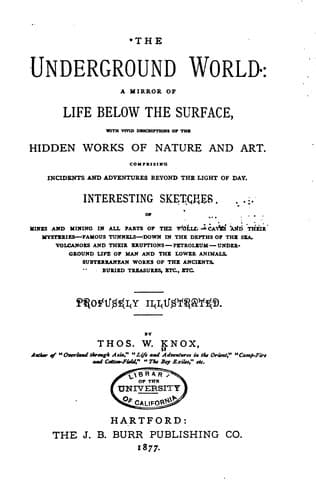
The Underground World: A mirror of life below the surfaceKnox, Thomas Wallace
History
The Underground World: A mirror of life below the surface
Knox, Thomas Wallace
Caves; Mines and mineral resources; Social history -- 19th century; Tunnels
On the night
in question, it rained so fast the hollow was soon a sheet of water,
which pressed with such force against the dam that it gave way. In
an instant, the fire-place was full to overflowing, and the Caffres,
thus rudely awakened, gave one mighty yell as the waters covered
them. Aroused by the noise, I peeped forth as they were struggling
out, their black heads showing around the edge of the fire-place like
those of so many hippopotami. After getting out, and giving some
hearty shakes, they commenced fishing up their bed-clothes from the
treacherous flood. Long before sunrise, next morning, they were at
the tent door, calling loudly for ‘soupies,’ or what we denominate
‘eye-openers,’ and certainly their condition, after what they had gone
through, demanded relief.”
[Sidenote: THE LUCKY ONES.]
Some of the stories told about the diamond finds are decidedly
attractive. Some of the earlier miners made large fortunes in a short
time. They had nothing to pay for their ground, and found from one
to twenty diamonds every day. When the price of claims went up, they
sold out, anywhere from two to ten thousand dollars, and went home.
One man made fifty thousand dollars in a month, divided his claim into
six parts, sold each part for one thousand five hundred dollars, and
went away satisfied. A ship was wrecked on the coast. The captain, of
course, was a very unfortunate man. Not knowing what to do, he went
to the diamond fields, where he stayed three months, and went away
with seventy-five thousand dollars. A Dutch Boer found, in one day,
thirty-one diamonds, which weighed respectively thirty-three carats,
eighteen, fifteen, nine, seven and a half, and other smaller ones.
He went away from the fields, and on returning, after an absence of
a month, his black servants, whom he had left in charge, turned over
to him more than three hundred diamonds. One man found a stone, at
the end of four days’ work, which brought him, in clean cash, eighty
thousand dollars.
[Sidenote: A CURIOUS FACT ABOUT DIAMONDS.]
A curious fact about the diamond is that it sometimes bursts. The
experts at the Cape can generally determine, by examining a stone,
whether it will burst or not. When first taken out, a small speck is
seen in it. If it is put aside in a dry place, it is in fragments
by the next morning. The miners keep such a stone in water or oil,
generally, until they find somebody green enough to buy it. The
bursting is caused by disappearance of moisture in the stone, and, of
course, it is retained there as long as the stone is kept moist.
XXVII.
THE UNDER-WORLD OF PARIS.
Public-domain text, read in full here on John Shaqi.
Reviews
Reviews
No reviews yet
Be the first to share your thoughts on this work.
Elsewhere in the archive
Join the Discussion
Join the discussion
Sign in to leave a comment or review.
Sign InorCreate an account