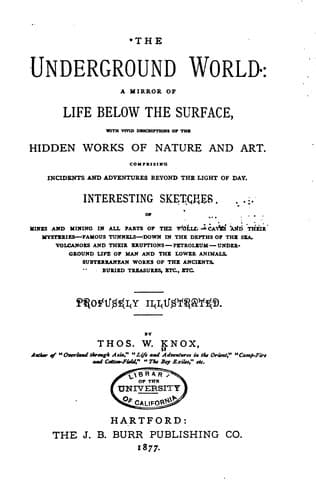
The Underground World: A mirror of life below the surfaceKnox, Thomas Wallace
History
The Underground World: A mirror of life below the surface
Knox, Thomas Wallace
Caves; Mines and mineral resources; Social history -- 19th century; Tunnels
Not a light was visible anywhere, and, as the night was dark, I asked
my guide if he were not mistaken in the locality. He assured me that
he was not, and, taking my hand, told me he would lead the way. I
could see nothing; but after we had stumbled along for a few seconds,
a flash of lightning revealed a long, narrow stone staircase before
us, and down this we slowly crept. At the base was a heavy oaken
door, which appeared as if it might withstand a battering-ram, and
I was wondering how we were to open it, when the detective put his
mouth to the key-hole, and gave a peculiar whistle. The door swung
open at once; we stepped into a dismal vestibule, and were confronted
by a huge figure, who grunted out, “_Tout bien_,” as he recognized
my companion, slammed to the door, and bolted it securely. So large
a Frenchman I had hardly seen. He was a giant in proportions, and I
discovered by a few phrases, that he was an Alsatian. He knew what
we wanted, and told us, pointing in the direction, to go to the main
hall, where, to translate him freely, the boys were very lively, and
having a good time.
A few steps brought us to the hall,—it should have been called a
cellar,—and in it were some fifty of the most villanous-looking men
and coarsest women I had ever had the misfortune to encounter. It was
evident, at a glance, that they were thieves, robbers, and assassins;
the slightest acquaintance with phrenology and physiognomy made that
clear—that some of them were of the sneak, some of the burglar, and
others of the desperado order. The place was dimly lighted with a few
sputtering candles; the ceiling was low, and the air mephitic. A few
of the men were standing and smoking pipes; but the greater part sat
at rough tables drinking and talking in hoarse tones, with vile oaths,
on subjects in which it was natural they should be interested.
A murder that had been committed a fortnight before in Marseilles, an
account of which had been printed in the Paris journals, occupied much
of their attention. They were very laudatory of the skilful manner in
which the crime had been perpetrated, and of the adroitness displayed
by the criminal in getting away. They had not a particle of pity for
the victim, an old and inoffensive man, whose throat had been cut
while he was asleep in bed, that a trunk in his apartment might be
broken open and plundered of a thousand francs.
The women, if they might be termed such, were more brutal and
bloodthirsty in their dispositions, judging from their expression,
than the men themselves. They were, as I was informed, either thieves
themselves or aids and accomplices of the thieves. Some of them were
what we should style shoplifters; others made it their business to
obtain information from servants in regard to private residences, and
imparted it to the burglars with whom they consorted.
[Sidenote: LOOKING AT A MURDERESS.]
Public-domain text, read in full here on John Shaqi.
Reviews
Reviews
No reviews yet
Be the first to share your thoughts on this work.
Elsewhere in the archive
Join the Discussion
Join the discussion
Sign in to leave a comment or review.
Sign InorCreate an account