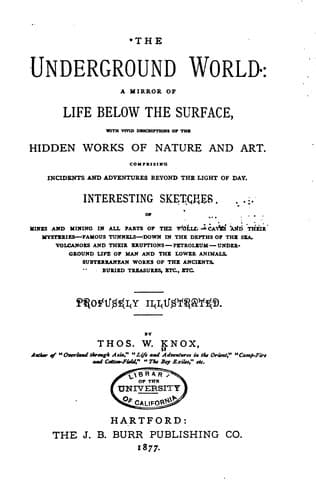
The Underground World: A mirror of life below the surfaceKnox, Thomas Wallace
History
The Underground World: A mirror of life below the surface
Knox, Thomas Wallace
Caves; Mines and mineral resources; Social history -- 19th century; Tunnels
Like their comrades whose story I have just told, the three last
colliers had fled before the water from the first moment of its
breaking in, and finding a rubbish passage stopped up, they
despairingly made an opening into it. They afterwards clambered to
the heading of the gallery as a last refuge. Their lamps were out,
but they heard the water rise, and retreated before it. The noise
occasioned by falls, and the breaking of timber, as well as the sound
of explosions caused by compressed air, reached their ears distinctly,
like a frightful tumult, which seemed to announce to them the last
hours they had to live. One of them had a repeating watch, which he
caused to strike several times; but it stopped on the morning of the
12th of October at a quarter to three o’clock. They heard the noise
of the tubs plunging into the water in two adjacent shafts. They
conceived the idea of reckoning the progress of time by means of
the short intervals of rest caused by changing the gangs. They thus
formed a very near guess at the period of their captivity, which they
reckoned at fifteen days, instead of thirteen.
To satisfy their hunger, they ate the rotten wood of the timber
supports, which they crumbled in water, and then devoured, having
previously eaten their leather belts. They could quench their thirst
at will, and that sustained them. Afterwards the water rose to where
they were, and wet their feet. Subsequently it fell, and then they
thought of fastening one of their boots to a string and drinking
out of it. Finding the water retiring, the child resolved to go in
search of an outlet. Swimming or holding on by the walls, he groped
his way along, but found nothing. Exhausted and chilled with cold, he
returned to his companions, who lay close to him to warm him, and then
covered him with small coal, in which position he was found.
[Sidenote: THIRTEEN DAYS IN DARKNESS.]
These men were liberated after being shut up thirteen days: the
temperature, the pressure, and the composition of the air in which
they were found, were favorable to life, and, moreover, they had the
means of quenching thirst. Under such conditions, it may be possible
to live a month. Our nature can endure a great deal when it is
compelled to exert itself. The energy and tenacity of life are great,
and few men know how much they can undergo until they are driven to
make the experiment.
Public-domain text, read in full here on John Shaqi.
Reviews
Reviews
No reviews yet
Be the first to share your thoughts on this work.
Elsewhere in the archive
Join the Discussion
Join the discussion
Sign in to leave a comment or review.
Sign InorCreate an account