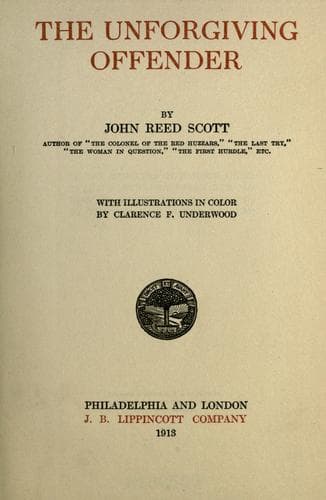
Rich people -- Fiction; United States -- Social life and customs -- Fiction
It was a peculiarly difficult situation; arising from causes simple
enough in themselves when taken separately, but extraordinarily
complicated when considered together. Stephanie, Gladys, Lorraine,
Amherst, Porshinger, Dolittle and himself--everyone a party acting
independently, so to speak, yet in effect acting together to attain the
present embarrassing condition. Naturally a woman was at the bottom of
it--she always is in such matters--and she would be the one to suffer
for all their foolishnesses and mistakes. Stephanie would be pilloried
because Porshinger and Dolittle and he himself had acted the cad--one
by nature, one because he was a malicious gossip, and one because he
was a natural born damn fool. The last was quite the most to blame
because he should and ought to have known better.
The more he pondered the situation, the more hopeless it became.
Amherst was out of it now except as an original cause. Lorraine was
only in it by right, and out of it on every other basis. Dolittle was
in it by reason of his disposition to meddle in the affairs of others;
but Porshinger and he were in it because they were guilty against
Stephanie. Technically Lorraine had a perfect right to prosecute
Porshinger--and Porshinger deserved to be prosecuted--but what of
himself? Who was the more guilty of the two? He had betrayed an implied
trust. It mattered not if Stephanie loved him--it mattered not that
she had no reproaches for him; he was guilty none the less, and had
only complicated the matter for her, for Porshinger had seen them--or
at least he knew. And Stephanie, the innocent cause of it all--of his
and Porshinger's audaciousness--was to be the real victim because of
Dolittle's babbling tongue and Lorraine's misdirected energy. The
whole thing, however, came back to Dolittle, so far as the present
complication was concerned. If he had not seen--or had been blind
though seeing--it would never have arisen.
However, none of these matters confronted them now. There was small
profit in searching for causes, or for whom to blame. Their business
was to meet a present condition in the best way possible--and there
appeared to be no best. All were equally bad. The more he thought over
it, the more hopeless it all was and the more futile every effort to
save Stephanie. She was bound to be smirched, take it whatever way one
would. If the prosecution was abandoned, then Dolittle's story would
be believed no matter how she treated Porshinger in the future. If the
prosecution was persisted in, then Porshinger's story of the willing
victim had to be met by Stephanie's story of violence--all the nasty
details threshed out for an eager populace--with Stephanie the real
defendant with all to lose and nothing to gain.--And if Porshinger
dragged him into it, by telling what he saw on the Criss-Cross piazza,
the verdict would scarcely be in doubt and the----
Public-domain text, read in full here on John Shaqi.
Reviews
Reviews
No reviews yet
Be the first to share your thoughts on this work.
Elsewhere in the archive
Join the Discussion
Join the discussion
Sign in to leave a comment or review.
Sign InorCreate an account