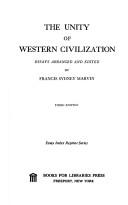
This unity of character is very largely due to continuous descent from a
common cultural ancestor. The civilization of the West is fundamentally
one not because the peoples of the West are one racially. They are not
so. They comprise every branch of the Aryan family and a considerable
admixture of quite other stocks. Their civilization owes its common
characteristics mainly to a common origin and continued interaction.
That is why it is in the mass a community of ideas, for ideas pass from
man to man and from nation to nation more readily than institutions,
more readily far than character, more readily perhaps than anything
except material goods. In the realm of ideas Western civilization forms
a single commonwealth of informal but of exceeding democratic
constitution. This freedom, indeed, it owes in large measure to its
international character, for there are constantly arising local and
temporary dictators, arbiters of fashion in the ideas of politics,
philosophy, and even of science. Within a narrow circle such a dictator
often has it all his own way, but it is seldom that he can maintain a
prolonged ascendancy throughout the international commonwealth unless
there is some pretty solid foundation for his doctrine.
This commonwealth has its foundations in the past. It derives in the
first instance from the unity of mediaeval Christendom, where it enjoyed
the advantage of a common language of learning, the gradual loss of
which is imperfectly compensated by the possession of two or three
modern languages alone by the educated man of the present day. Through
mediaeval Christendom and through the Arabic schools, which can hardly
be regarded as a part of Western civilization but in the Middle Ages
were rather its teachers, it derives from the Greco-Roman world, and
through the Greco-Roman world from the Greeks themselves. The Greeks in
their turn were aware that they owed the rudiments of their science to
the ancient civilizations of the Nile and the Euphrates. Thus in the
intellectual world there is a continuity stretching back six thousand
years or more to the beginnings of recorded civilization. More than once
the continuity is nearly broken, but some strand is always preserved,
and it is in this continuity in the world of ideas that we get the main
evidence of such progress as human history reveals.
Public-domain text, read in full here on John Shaqi.
Reviews
Reviews
No reviews yet
Be the first to share your thoughts on this work.
Elsewhere in the archive
Join the Discussion
Join the discussion
Sign in to leave a comment or review.
Sign InorCreate an account