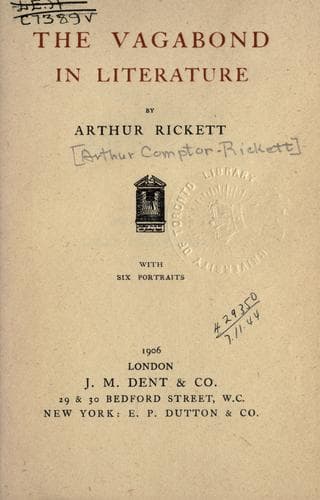
Bohemianism; English literature -- 19th century -- History and criticism
Such are his comrades. And well he knows them. For many years of his
life he was roving through country and city, coming into daily contact
with the men and women about whom he has sung. Walt Whitman—farm boy,
school teacher, printer, editor, traveller, mechanic, nurse in the army
hospital, Government clerk. Truly our poet has graduated as few have
done in the school of Life. No writer of our age has better claims to be
considered the Poet of Democracy.
But he was no sentimentalist. More tolerant and passive in disposition
than Victor Hugo, he had the same far-seeing vision when dealing with the
people. He recognized their capacity for good, their unconquerable
faith, their aspirations, their fine instincts; but he recognized also
their brutality and fierceness. He would have agreed with Spencer’s
significant words: “There is no alchemy by which you can get golden
conduct out of leaden instincts”; but he would have denied Spencer’s
implication that leaden instincts ruled the Democracy. And he was right.
There is more real knowledge of men and women in _Leaves of Grass_ and
_Les Miserables_ than in all the volumes of the Synthetic Philosophy.
Thus Whitman announces his theme:—
“Of Life immense in passion, pulse, and power,
Cheerful, for freest action formed under the laws divine.
The modern man I sing.”
“Whitman,” wrote the late Mr. William Clarke, in his stimulating study of
the Poet, {188} “sings of the Modern Man as workman, friend, citizen,
brother, comrade, as pioneer of a new social order, as both material and
spiritual, final and most subtle, compound of spirit and nature, firmly
planted on this rolling earth, and yet ‘moving about in worlds not
realized.’ As representative democratic bard Whitman exhibits complete
freedom from unconventionality, a very deep human love for all, faith in
the rationality of the world, courage, energy, and the instincts of
solidarity.”
In the introductory essay to this volume some remarks were made about the
affections of the literary Vagabond in general and of Whitman in
particular, which call now for an ampler treatment, especially as on this
point I find myself, apparently, at issue with so many able and
discerning critics of Whitman. I say apparently because a consideration
of the subject may show that the difference, though real, is not so
fundamental as it appears to be.
That Whitman entertained a genuine affection for men and women is, of
course, too obvious to be gainsaid. His noble work in the hospitals, his
tenderness towards criminals and outcasts—made known to us through the
testimony of friends—show him to be a man of comprehensive sympathies.
No man of a chill and calculating nature could have written as he did,
and, although his writings are not free of affectation, the strenuous,
fundamental sincerity of the man impresses every line.
Public-domain text, read in full here on John Shaqi.
Reviews
Reviews
No reviews yet
Be the first to share your thoughts on this work.
Elsewhere in the archive
Join the Discussion
Join the discussion
Sign in to leave a comment or review.
Sign InorCreate an account