“It would take as many for me.” Valiant laughed a little. “You who have
always lived here, can scarcely understand what I am feeling, I imagine.
You see, I never knew till quite recently—my childhood was largely
spent abroad, and I have no near relatives—that my father was a
Virginian and that my ancestors always lived here. To discover this all
at once and to come to this house, with their portraits on the walls and
their names on the title-pages of these books!” He made a gesture toward
the glass shelves. “Why, there’s a room up-stairs with the very toys
they played with when they were children! To learn that I belong to it
all; that I myself am the last link in such a chain!”
“The ancestral instinct,” said the doctor. “I’m glad to see that it
means something still, in these rotten days.”
“Of course,” John Valiant continued, “every one knows that he has
ancestors. But I’m beginning to see that what you call the ancestral
instinct needs [Pg 205]a locality and a place. In a way it seems to me that an
old estate like this has a soul too—a sort of clan or family soul that
reacts on the descendant.”
“Rather a Japanesy idea, isn’t it?” observed the major. “But I know what
you mean. Maybe that’s why old Virginian families hang on to their land
in spite of hell and high-water. They count their forebears real live
people, quite capable of turning over in their graves.”
“Mine are beginning to seem very real to me. Though I don’t even know
their Christian names yet, I can judge them by their handiwork. The men
who built Damory Court had a sense of beauty and of art.”
“And their share of deviltry, too,” put in the doctor.
“I suppose so,” admitted his host. “At this distance I can bear even
that. But good or bad, I’m deeply thankful that they chose Virginia.
Since I’ve been laid up, I’ve been browsing in the library here—”
“A bit out of date now, I reckon,” said the major, “but it used to pass
muster. Your grandfather was something of a book-worm. He wrote a
history of the family, didn’t he?”
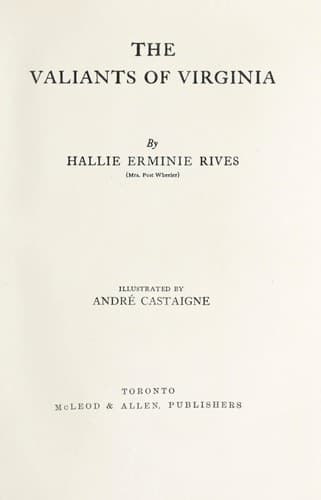
“Yes. I’ve found it. The Valiants of Virginia. I’m reading the
Revolutionary chapters now. It never seemed real before—it’s been only
[Pg 206]a slice of impersonal and rather dull history. But the book has made it
come alive. I’m having the thrill of the globe-trotter the first time he
sees the Tower of London or the field of Waterloo. I see more than that
stubble-field out yonder; I see a big wooden stockade with soldiers in
ragged buff and blue guarding it.”
The major nodded, “Ah, yes,” he said. “The Continental prison-camp.”
“And just over the rise there I can see an old court-house, and the
Virginia Assembly boiling under the golden tongue-lashing of lean
raw-boned Patrick Henry. I see a messenger gallop up and see the members
scramble to their saddles—and then, Tarleton and his red-coats
streaming up, too late.”
Public-domain text, read in full here on John Shaqi.
Reviews
Reviews
No reviews yet
Be the first to share your thoughts on this work.
Elsewhere in the archive
Join the Discussion
Join the discussion
Sign in to leave a comment or review.
Sign InorCreate an account