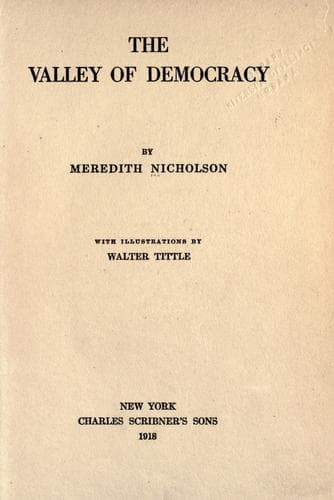
Mississippi River Valley -- Social life and customs
If I may delicately suggest the point without making too great a
concession, the West is really quite human. It has its own “slant”--its
tastes and preferences that differ in ways from those of the East,
the South, or the farther West; and radicals are distributed through
the corn belt in about the same proportion as elsewhere. The
bread-and-butter Western Folks are pretty sensible, taken in the long
run, and not at all anxious to pull down the social pillars just
to make a noise. They will impiously carve them a little--yes, and
occasionally stick an incongruous patch on the wall of the sanctuary
of democracy; but they are never wilfully destructive. And it cannot
be denied that some of their architectural and decorative efforts have
improved the original design. The West has saved other sections a good
deal of trouble by boldly experimenting with devices it had “thought
up” amid the free airs of the plains; but the West, no more than the
East, will give storage to a contrivance that has been proved worthless.
The vindictive spirit that was very marked in the Western attitude
toward the railroads for many years was not a gratuitous and unfounded
hatred of corporations, but had a real basis in discriminations that
touched vitally the life of the farmer and the struggling towns to
which he carried his products. The railroads were the only corporations
the West knew before the great industrial development. A railroad
represented “capital,” and “capital” was therefore a thing to chastise
whenever opportunity offered. It has been said in bitterness of
late that the hostile legislation demanded by the West “ruined the
railroads.” This is not a subject for discussion here, but it can
hardly be denied that the railroads invited the war that was made upon
them by injustices and discriminations of which the obscure shipper
had a right to complain. The antagonism to railroads inspired a great
deal of radicalism aimed at capital generally, and “corporate greed,”
“the encroachments of capital,” “the money devils of Wall Street,” and
“special privilege” burned fiercely in our political terminology. Our
experiment with government control as a war measure has, of course,
given a new twist to the whole transportation problem.
Public-domain text, read in full here on John Shaqi.
Reviews
Reviews
No reviews yet
Be the first to share your thoughts on this work.
Elsewhere in the archive
Join the Discussion
Join the discussion
Sign in to leave a comment or review.
Sign InorCreate an account