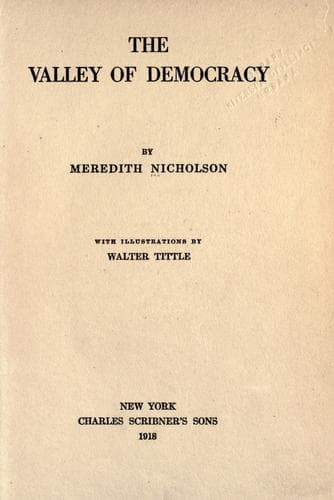
Mississippi River Valley -- Social life and customs
A _professor_, it is said, wishing to curry favor with his royal
pupil, informed him _overnight_ of the chapter in Greek that was to
be made the _subject_ of the next day’s lesson.
The young _prince_ did what many boys would not have done. As soon as
the classroom was _opened_ on the following morning, he entered and
wrote _conspicuously_ on the blackboard the _information_ that had
been given him.
One may say _unhesitatingly_ that a boy capable of such an action has
the root of a fine _character_ in him, _possesses_ that _chivalrous_
sense of fair play which is the nearest thing to a _religion_ that
may be looked for at that age, hates _meanness_ and _favoritism_,
and will, _wherever possible_, expose them. There is in him a
_fundamental_ bent toward what is clean, manly, and aboveboard.
The copy of the book before me bears the imprint, “Board of Education,
City of Chicago, 1914.” The Kaiser’s “chivalrous sense of fair play”
has, of course, ceased to be a matter of public instruction in the
Western metropolis.
“Im Vaterland,” a German reading-book used in a number of Western
schools, states frankly in its preface that it was “made in Germany,”
and that “after the manuscript had been completed it was manifolded and
copies were criticised by teachers in Prussia, Saxony, and Bavaria.”
In contrast with the equivocal loyalty of Germans who have sought to
perpetuate and accentuate the hyphen, it is a pleasure to testify to
the admirable spirit with which the Jewish people in these Western
States have repeatedly manifested their devotion to America. Many of
these are of German birth or the children of German immigrants, and yet
I am aware of no instance of a German Jew in the region most familiar
to me who has not warmly supported the American cause. They have not
only given generously to the Red Cross and to funds for French and
Belgian relief, quite independently of their efforts in behalf of
people of their own race in other countries, but they have rendered
most important aid in all other branches of war activities. No finer
declaration of whole-hearted Americanism has been made by any American
of German birth than that expressed (significantly at Milwaukee) by
Mr. Otto H. Kahn, of New York, last January:
Public-domain text, read in full here on John Shaqi.
Reviews
Reviews
No reviews yet
Be the first to share your thoughts on this work.
Elsewhere in the archive
Join the Discussion
Join the discussion
Sign in to leave a comment or review.
Sign InorCreate an account