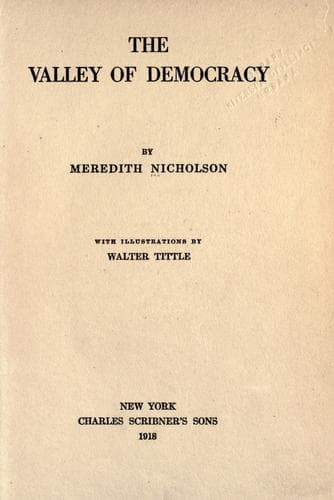
Mississippi River Valley -- Social life and customs
The farmer and his household have found themselves in recent years
the object of embarrassing attentions not only from Washington,
the land-grant colleges, and the experiment-stations, but countless
private agencies have “discovered” the farmer and addressed themselves
determinedly to the amelioration of his hardships. The social surveyor,
having analyzed the city slum to his satisfaction, springs from his
automobile at the farmhouse door and asks questions of the bewildered
occupants that rouse the direst apprehensions. Sanitarians invade the
premises and recommend the most startling changes and improvements.
Once it was possible for typhoid or diphtheria to ravage a household
without any interference from the outside world; now a health officer
is speedily on the premises to investigate the old oaken bucket, the
iron-bound bucket, that hangs in the well, and he very likely ties
and seals the well-sweep and bids the farmer bore a new well, in a
spot kindly chosen for him, where the barn-lot will not pollute his
drinking-water. The questionnaire, dear to the academic investigator,
is constantly in circulation. Women’s clubs and federations thereof
ponder the plight of the farmer’s wife and are eager to hitch her
wagon to a star. Home-mission societies, alarmed by reports of the
decay of the country church, have instituted surveys to determine the
truth of this matter. The consolidation of schools, the introduction
of comfortable omnibuses to carry children to and from home, the
multiplication of country high schools, with a radical revision of the
curriculum, the building of two-story schoolhouses in place of the old
one-room affair in which all branches were taught at once, and the use
of the schoolhouse as a community centre--these changes have dealt a
blow to the long-established ideal of the red-mittened country child,
wading breast-high through snow to acquaint himself with the three
R’s and, thus fortified, enter into the full enjoyment of American
democracy. Just how Jefferson would look upon these changes and this
benignant paternalism I do not know, nor does it matter now that
American farm products are reckoned in billions and we are told that
the amount must be increased or the world will starve.
The farmer’s mail, once restricted to an occasional letter, began to be
augmented by other remembrances from Washington than the hollyhock-seed
his congressman occasionally conferred upon the farmer’s wife.
Pamphlets in great numbers poured in upon him, filled with warnings and
friendly counsel. The soil he had sown and reaped for years, in the
full confidence that he knew all its weaknesses and possibilities, he
found to be something very different and called by strange names. His
lifelong submission to destructive worms and hoppers was, he learned,
unnecessary if not criminal; there were ways of eliminating these
enemies, and he shyly discussed the subject with his neighbors.
Public-domain text, read in full here on John Shaqi.
Reviews
Reviews
No reviews yet
Be the first to share your thoughts on this work.
Join the Discussion
Join the discussion
Sign in to leave a comment or review.
Sign InorCreate an account