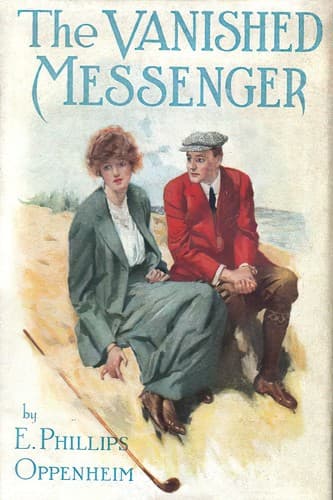
The Vanished MessengerOppenheim, E. Phillips (Edward Phillips)
General
The Vanished Messenger
Oppenheim, E. Phillips (Edward Phillips)
Detective and mystery stories; Fiction
“I think,” he said, “that I should like to see the last of Mr. Dunster.”
“Pray do,” Mr. Fentolin begged. “I have said good-by to him myself, and
all that I hope is that next time you offer a wayfarer the hospitality
of St. David’s Hall, Gerald, he may be a more tractable person. This
morning I shall give myself a treat. I shall eat an old-fashioned
English breakfast. Close the door after you, if you please, Gerald.”
Hamel, with Gerald by his side, hurried out into the hall. Just as they
crossed the threshold they saw Mr. Dunster, wrapped from head to foot
in his long ulster, a soft hat upon his head and one of Mr. Fentolin’s
cigars in his mouth, step from the bottom stair into the hall and make
his way with somewhat uncertain footsteps towards the front door. Doctor
Sarson walked on one side, and Meekins held him by the arm. He glanced
towards Gerald and his companion and waved the hand which held his
cigar.
“So long, my young friend!” he exclaimed. “You see, I’ve got them to
let me make a start. Next time we go about the country in a saloon car
together, I hope we’ll have better luck. Say, but I’m groggy about the
knees!”
“You’d better save your breath,” Doctor Sarson advised him grimly. “You
haven’t any to spare now, and you’ll want more than you have before you
get to the end of your journey. Carefully down the steps, mind.”
They helped him into the car. Hamel and Gerald stood under the great
stone portico, watching.
“Well, I’m jiggered!” the boy exclaimed, under his breath.
Hamel was watching the proceedings with a puzzled frown. To his
surprise, neither Doctor Sarson nor Meekins were accompanying the
departing man.
“He’s off, right enough,” Hamel declared, as the car glided away. “Do
you understand it? I don’t.”
Gerald did not speak for several moments. His eyes were still fixed upon
the back of the disappearing car. Then he turned towards Hamel.
“There isn’t much,” he said softly, “that Mr. Fentolin doesn’t know. If
that detective was really on his way here, there wasn’t any chance
of keeping Mr. Dunster to himself. You see, the whole story is common
property. And yet, there’s something about the affair that bothers me.”
“And me,” Hamel admitted, watching the car until it became a speck in
the distance.
“He was fairly well cornered,” Gerald concluded, as they made their way
back to the dining-room, “but it isn’t like him to let go of anything so
easily.”
“So you’ve seen the last of our guest,” Mr. Fentolin remarked, as Hamel
and Gerald re-entered the dining-room. “A queer fellow--almost a new
type to me. Dogged and industrious, I should think. He hadn’t the least
right to travel, you know, and I think so long as we had taken the
trouble to telephone to Norwich, he might have waited to see the
physician. Sarson was very angry about it, but what can you do with
these fellows who are never ill? They scarcely know what physical
disability means. Well, Mr. Hamel, and how are you going to amuse
yourself to-day?”
Public-domain text, read in full here on John Shaqi.
Reviews
Reviews
No reviews yet
Be the first to share your thoughts on this work.
Elsewhere in the archive
Join the Discussion
Join the discussion
Sign in to leave a comment or review.
Sign InorCreate an account