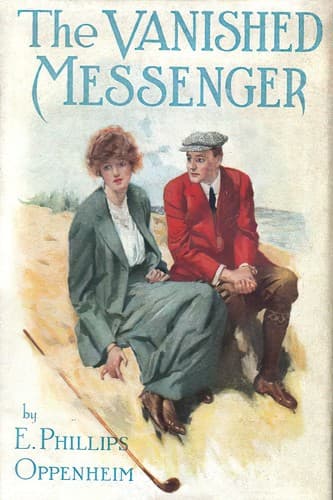
The Vanished MessengerOppenheim, E. Phillips (Edward Phillips)
General
The Vanished Messenger
Oppenheim, E. Phillips (Edward Phillips)
Detective and mystery stories; Fiction
“Mr. Hamel,” she said, “tell me--what of your mission? You have had an
opportunity of studying my uncle. You have even lived under his roof.
Tell me what you think.”
His face was troubled.
“Miss Fentolin,” he said, “I will tell you frankly that up to now I have
not succeeded in solving the problem of your uncle’s character. To me
personally he has been most courteous. He lives apparently a
studious and an unselfish life. I have heard him even spoken of as a
philanthropist. And yet you three--you, your mother, and your brother,
who are nearest to him, who live in his house and under his protection,
have the air of passing your days in mortal fear of him.”
“Mr. Hamel,” she exclaimed nervously, “you don’t believe that! He is
always very kind.”
“Apparently,” Hamel observed drily. “And yet you must remember that you,
too, are afraid of him. I need not remind you of our conversations, but
there the truth is. You praise his virtues and his charities, you pity
him, and yet you go about with a load of fear, and--forgive me--of
secret terror in your heart, you and Gerald, too. As for your mother--”
“Don’t!” she interrupted suddenly. “Why do you bring me here to talk
like this? You cannot alter things. Nothing can be altered.”
“Can’t it!” he replied. “Well, I will tell you the real reason of my
having brought you here and of my having made this confession. I brought
you here because I could not bear to go on living, if not under your
roof, at any rate in the neighbourhood, without telling you the truth.
Now you know it. I am here to watch Mr. Fentolin. I am going on watching
him. You can put him on his guard, if you like; I shan’t complain. Or
you can--”
He paused so long that she looked at him. He moved a little closer to
her, his fingers suddenly gripped her hand.
“Or you can marry me and come away from it all,” he concluded quietly.
“Forgive me, please--I mean it.”
For a moment the startled light in her eyes was followed by a delicious
softness. Her lips were parted, she leaned a little towards him. Then
suddenly she seemed to remember. She rose with swift alertness to her
feet.
“I think,” she said, “that we had better play golf.”
“But I have asked you to marry me,” he protested, as he scrambled up.
“Your caddy has found your ball a long time ago,” she pointed out,
walking swiftly on ahead.
He played his shot and caught her up.
“Miss Fentolin--Esther,” he pleaded eagerly, “do you think that I am not
in earnest? Because I am. I mean it. Even if I have only known you for a
few days, it has been enough. I think that I knew it was coming from the
moment that you stepped into my railway carriage.”
“You knew that what was coming?” she asked, raising her eyes suddenly.
“That I should care for you.”
“It’s the first time you’ve told me,” she reminded him, with a queer
little smile. “Oh, forgive me, please! I didn’t mean to say that.
I don’t want to have you tell me so. It’s all too ridiculous and
impossible.”
“Is it? And why?”
Public-domain text, read in full here on John Shaqi.
Reviews
Reviews
No reviews yet
Be the first to share your thoughts on this work.
Elsewhere in the archive
Join the Discussion
Join the discussion
Sign in to leave a comment or review.
Sign InorCreate an account