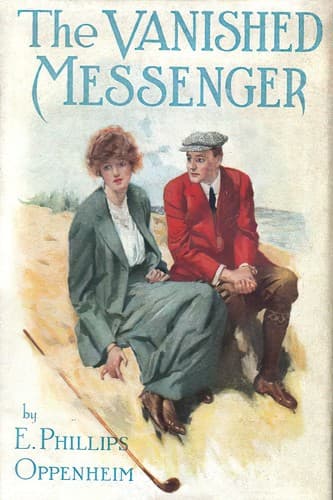
The Vanished MessengerOppenheim, E. Phillips (Edward Phillips)
General
The Vanished Messenger
Oppenheim, E. Phillips (Edward Phillips)
Detective and mystery stories; Fiction
Hamel strolled down the terrace steps and wandered for a time in the
gardens behind the house. Here, in the shelter of the great building, he
found himself suddenly in an atmosphere of springtime. There were
beds of crocuses and hyacinths, fragrant clumps of violets, borders of
snowdrops, masses of primroses and early anemones. He slowly climbed one
or two steep paths until he reached a sort of plateau, level with the
top of the house. The flowers here grew more sparsely, the track of the
salt wind lay like a withering band across the flower-beds. The garden
below was like a little oasis of colour and perfume. Arrived at the
bordering red brick wall, he turned around and looked along the narrow
road which led to the sea. There was no sign of Mr. Fentolin’s return.
Then to his left he saw a gate open and heard the clamour of dogs.
Esther appeared, walking swiftly towards the little stretch of road
which led to the village. He hurried after her.
“Unsociable person!” he exclaimed, as he caught her up. “Didn’t you know
that I was longing for a walk?”
“How should I read your thoughts?” she answered. “Besides, a few minutes
ago I saw you on the terrace, talking to mother. I am only going as far
as the village.”
“May I come?” he asked. “I have business there myself.”
She laughed.
“There are nine cottages, three farmhouses, and a general shop in St.
David’s,” she remarked. “Also about fifteen fishermen’s cottages dotted
about the marsh. Your business, I presume, is with the general shop?”
He shook his head, falling into step with her.
“What I want,” he explained, “is to find a woman to come in and look
after me at the Tower. Your servant who valets me has given me two
names.”
Something of the lightness faded from her face.
“So you have quite made up your mind to leave us?” she asked slowly.
“Mother wasn’t able to persuade you to stay?”
He shook his head.
“She was very kind,” he said, “but there are really grave reasons why
I feel that I must not accept Mr. Fentolin’s hospitality any longer. I
had,” he went on, “a very interesting talk with your mother.”
She turned quickly towards him. The slightest possible tinge of
additional colour was in her cheeks. She was walking on the top of a
green bank, with the wind blowing her skirts around her. The turn of
her head was a little diffident, almost shy. Her eyes were asking him
questions. At that moment she seemed to him, with her slim body, her
gently parted lips and soft, tremulous eyes, almost like a child. He
drew a little nearer to her.
“I told your mother,” he continued, “all that I have told you, and
more. I told her, dear, that I cared for you, that I wanted you to be my
wife.”
She was caught in a little gust of wind. Both her hands went up to her
hat; her face was hidden. She stepped down from the bank.
“You shouldn’t have done that,” she said quietly.
“Why not?” he demanded. “It was the truth.”
Public-domain text, read in full here on John Shaqi.
Reviews
Reviews
No reviews yet
Be the first to share your thoughts on this work.
Elsewhere in the archive
Join the Discussion
Join the discussion
Sign in to leave a comment or review.
Sign InorCreate an account