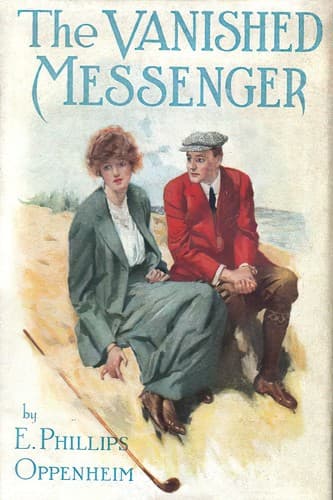
The Vanished MessengerOppenheim, E. Phillips (Edward Phillips)
General
The Vanished Messenger
Oppenheim, E. Phillips (Edward Phillips)
Detective and mystery stories; Fiction
“I agree,” Mrs. Fentolin said firmly. “We have gone on from sacrifice
to sacrifice, until it has become a habit with us to consider him the
master of our bodies and our souls. To-day, Esther, we have reached the
breaking point. Not even for the sake of that message from the other
side of the grave, not even to preserve his honour and his memory, can
we do more.”
Hamel held up his finger. He opened the French windows, and they
followed him out on to the terrace. The grey dawn had broken now over
the sea. There were gleams of fitful sunshine on the marshes. Some
distance away a large motor-car was coming rapidly along the road.
CHAPTER XXXIV
Mr. John P. Dunster, lying flat upon his little bed, watched with
dilated eyes the disappearance of the ladder. Then he laughed. It was a
queer sound--broken, spasmodic, devoid of any of the ordinary elements
of humor--and yet it was a laugh. Mr. Fentolin turned his head towards
his prisoner and nodded thoughtfully.
“What a constitution, my friend!” he exclaimed, without any trace of
disturbance in his voice. “And what a sense of humour! Strange that a
trifling circumstance like this should affect it. Meekins, burn some
more of the powder. The atmosphere down here may be salubrious, but I am
unaccustomed to it.”
“Perhaps,” Mr. Dunster said in a hollow tone, “you will have some
opportunity now of discovering with me what it is like.”
“That, too, is just possible,” Mr. Fentolin admitted, blowing out a
little volume of smoke from a cigarette which he had just lit, “but one
never knows. We have friends, and our position, although, I must admit,
a little ridiculous, is easily remedied. But how that mischief-making
Mr. Hamel could have found his way into the boat-house does, I must
confess, perplex me.”
“He must have been hanging around and followed us in when we came,”
Meekins muttered. “Somehow, I fancied I felt some one near.”
“Our young friend,” Mr. Fentolin continued, “has, without doubt, an
obvious turn of mind. He will send for his acquaintance in the Foreign
Office; they will haul out Mr. Dunster here, and he will have a belated
opportunity of delivering his message at The Hague.”
“You aren’t going to murder me first, then?” Mr. Dunster grunted.
Mr. Fentolin smiled at him benignly.
“My dear and valued guest,” he protested, “why so forbidding an idea?
Let me assure you from the bottom of my heart that any bodily harm to
you is the most unlikely thing in the world. You see, though you might
not think it,” he went on, “I love life. That is why I keep a doctor
always by my side. That is why I insist upon his making a complete study
of my constitution and treating me in every respect as though I were
indeed an invalid. I am really only fifty-nine years old. It is my
intention to live until I am eighty-nine. An offence against the law of
the nature you indicate might interfere materially with my intentions.”
Mr. Dunster struggled for a moment for breath.
Public-domain text, read in full here on John Shaqi.
Reviews
Reviews
No reviews yet
Be the first to share your thoughts on this work.
Elsewhere in the archive
Join the Discussion
Join the discussion
Sign in to leave a comment or review.
Sign InorCreate an account