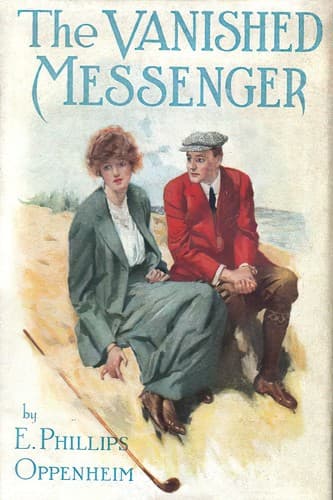
The Vanished MessengerOppenheim, E. Phillips (Edward Phillips)
General
The Vanished Messenger
Oppenheim, E. Phillips (Edward Phillips)
Detective and mystery stories; Fiction
“Dear lady,” Mr. Fentolin said, “I am one of those who benefit by the
law of compensations. On a morning like this I can spend hours merely
feasting my eyes upon this prospect, and I can find, if not happiness,
the next best thing. The world is full of beautiful places, but the
strange part of it is that beauty has countless phases, and each phase
differs in some subtle and unexplainable manner from all others. Look
with me fixedly, dear Lady Saxthorpe. Look, indeed, with more than your
eyes. Look at that flush of wild lavender, where it fades into the sands
on one side, and strikes the emerald green of that wet seamoss on the
other. Look at the liquid blue of that tongue of sea which creeps along
its bed through the yellow sands, through the dark meadowland, which
creeps and oozes and widens till in an hour’s time it will have become a
river. Look at my sand islands, virgin from the foot of man, the home of
sea-gulls, the islands of a day. There may be other and more beautiful
places. There is none quite like this.”
“I pity you no longer,” Lady Saxthorpe asserted fervently. “The eyes of
the artist are a finer possession than the limbs of the athlete.”
The butler announced luncheon, and they all trooped in. Hamel found
himself next to Lady Saxthorpe.
“Dear Mr. Fentolin has been so kind,” she confided to him as they took
their places. “I came in fear and trembling to ask for a very small
cheque for my dear brother’s diocese. My brother is a colonial bishop,
you know. Can you imagine what Mr. Fentolin has given me?”
Hamel wondered politely. Lady Saxthorpe continued with an air of
triumph.
“A thousand pounds! Just fancy that--a thousand pounds! And some
people say he is so difficult,” she went on, dropping her voice. “Mrs.
Hungerford came all the way over from Norwich to beg for the infirmary
there, and he gave her nothing.”
“What was his excuse?” Hamel asked.
“I think he told her that it was against his principles to give to
hospitals,” Lady Saxthorpe replied. “He thinks that they should be
supported out of the rates.”
“Some people have queer ideas of charity,” Hamel remarked. “Now I am
afraid that if I had been Mr. Fentolin, I would have given the thousand
pounds willingly to a hospital, but not a penny to a mission.”
Mr. Fentolin looked suddenly down the table. He was some distance away,
but his hearing was wonderful.
“Ah, my dear Hamel,” he said, “believe me, missions are very wonderful
things. It is only from a very careful study of their results that I
have brought myself to be a considerable supporter of those where I have
some personal knowledge of the organisation. Hospitals, on the other
hand, provide for the poor what they ought to be able to provide for
themselves. The one thing to avoid in the giving away of money is
pauperisation. What do you think, Florence?”
His sister-in-law, who was seated at the other end of the table, looked
across at him with a bright but stereotyped smile.
Public-domain text, read in full here on John Shaqi.
Reviews
Reviews
No reviews yet
Be the first to share your thoughts on this work.
Elsewhere in the archive
Join the Discussion
Join the discussion
Sign in to leave a comment or review.
Sign InorCreate an account