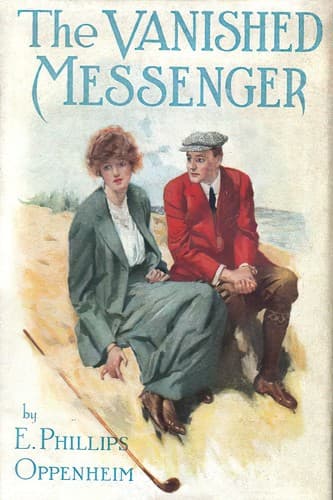
The Vanished MessengerOppenheim, E. Phillips (Edward Phillips)
General
The Vanished Messenger
Oppenheim, E. Phillips (Edward Phillips)
Detective and mystery stories; Fiction
“There are a few minor points,” Mr. Fentolin murmured, “such as his
religious convictions and his size in boots, which I could not swear
about, but so far as regards his name and his occupation, I think I can
gratify your curiosity. He is a Mr. John P. Dunster, and he appears
to be the representative of an American firm of bankers, on his way to
Germany to conclude a loan.”
“God bless my soul!” Lord Saxthorpe exclaimed wonderingly. “The fellow
is actually here under this roof! But who brought him? How did he find
his way?”
“Better ask Gerald,” Mr. Fentolin replied. “He is the abductor. It seems
that they both missed the train from Liverpool Street, and Mr. Dunster
invited Gerald to travel down in his special train. Very kind of him,
but might have been very unlucky for Gerald. As you know, they got
smashed up at Wymondham, and Gerald, feeling in a way responsible for
him, brought him on here; quite properly, I think. Sarson has been
looking after him, but I am afraid he has slight concussion of the
brain.”
“I shall remember this all my life,” Lord Saxthorpe declared solemnly,
“as one of the most singular coincidences which has ever come within my
personal knowledge. Perhaps after lunch, Mr. Fentolin, you will let some
of your people telephone to the police-station at Wells? There really is
an important enquiry respecting this man. I should not be surprised,” he
added, dropping his voice a little for the benefit of the servants, “to
find that Scotland Yard needed him on their own account.”
“In that case,” Mr. Fentolin remarked, “he is quite safe, for Sarson
tells me there is no chance of his being able to travel, at any rate for
twenty-four hours.”
Lady Saxthorpe shivered.
“Aren’t you afraid to have him in the house?” she asked, “a man who is
really and actually wanted by Scotland Yard? When one considers that
nothing ever happens here except an occasional shipwreck in the winter
and a flower-show in the summer, it does sound positively thrilling. I
wonder what he has done.”
They discussed the subject of Mr. Dunster’s possible iniquities.
Meanwhile, a young man carrying his hat in his hand had slipped in past
the servants and was leaning over Mr. Fentolin’s chair. He laid two
or three sheets of paper upon the table and waited while his employer
glanced them through and dismissed him with a little nod.
“My wireless has been busy this morning,” Mr. Fentolin remarked. “We
seem to have collected about forty messages from different battleships
and cruisers. There must be a whole squadron barely thirty miles out.”
“You don’t really think,” Lady Saxthorpe asked, “that there is any fear
of war, do you, Mr. Fentolin?”
He answered her with a certain amount of gravity. “Who can tell? The
papers this morning were bad. This conference at The Hague is still
unexplained. France’s attitude in the matter is especially mysterious.”
Public-domain text, read in full here on John Shaqi.
Reviews
Reviews
No reviews yet
Be the first to share your thoughts on this work.
Elsewhere in the archive
Join the Discussion
Join the discussion
Sign in to leave a comment or review.
Sign InorCreate an account