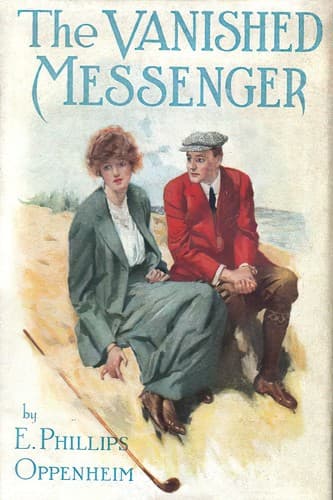
The Vanished MessengerOppenheim, E. Phillips (Edward Phillips)
General
The Vanished Messenger
Oppenheim, E. Phillips (Edward Phillips)
Detective and mystery stories; Fiction
“I am losing a great deal of sympathy for you, Mr. Fentolin,” Lady
Saxthorpe confessed, coming over to his side. “You have so many
resources, there is so much in life which you can do. You paint, as
we all know, exquisitely. They tell me that you play the violin like a
master. You have unlimited time for reading, and they say that you are
one of the greatest living authorities upon the politics of Europe. Your
morning paper must bring you so much that is interesting.”
“It is true,” Mr. Fentolin admitted, “that I have compensations which no
one can guess at, compensations which appeal to me more as time steals
on. And yet--”
He stopped short.
“And yet?” Lady Saxthorpe repeated interrogatively.
Mr. Fentolin was watching Gerald drive golf balls from the lawn beneath.
He pointed downwards.
“I was like that when I was his age,” he said quietly.
CHAPTER XIX
Mr. Fentolin remained upon the terrace long after the departure of his
guests. He had found a sunny corner out of the wind, and he sat there
with a telescope by his side and a budget of newspapers upon his
knee. On some pretext or another he had detained all the others of the
household so that they formed a little court around him. Even Hamel,
who had said something about a walk, had been induced to stop by an
appealing glance from Esther. Mr. Fentolin was in one of his most
loquacious moods. For some reason or other, the visit of the Saxthorpes
seemed to have excited him. He talked continually, with the briefest
pauses. Every now and then he gazed steadily across the marshes through
his telescope.
“Lord Saxthorpe,” he remarked, “has, I must confess, greatly excited
my curiosity as to the identity of our visitor. Such a harmless-looking
person, he seems, to be causing such a commotion. Gerald, don’t you feel
your responsibility in the matter?”
“Yes, sir, I do!” Gerald replied, with unexpected grimness. “I feel my
responsibility deeply.”
Mr. Fentolin, who was holding the telescope to his eye, touched Hamel on
the shoulder.
“My young friend,” he said, “your eyes are better than mine. You see the
road there? Look along it, between the white posts, as far as you can.
What do you make of that black speck?”
Hamel held the telescope to his eye and steadied it upon the little
tripod stand.
“It looks like a horse and trap,” he announced. “Good!” Mr. Fentolin
declared. “It seemed so to me, but I was not sure. My eyes are weak this
afternoon. How many people are in the trap?”
“Two,” Hamel answered. “I can see them distinctly now. One man is
driving, another is sitting by his side. They are coming this way.”
Mr. Fentolin blew his whistle. Meekins appeared almost directly. His
master whispered a word in his ear. The man at once departed.
“Let me make use of your eyes once more,” Mr. Fentolin begged. “About
these two men in the trap, Mr. Hamel. Is one of them, by any chance,
wearing a uniform?”
Public-domain text, read in full here on John Shaqi.
Reviews
Reviews
No reviews yet
Be the first to share your thoughts on this work.
Elsewhere in the archive
Join the Discussion
Join the discussion
Sign in to leave a comment or review.
Sign InorCreate an account