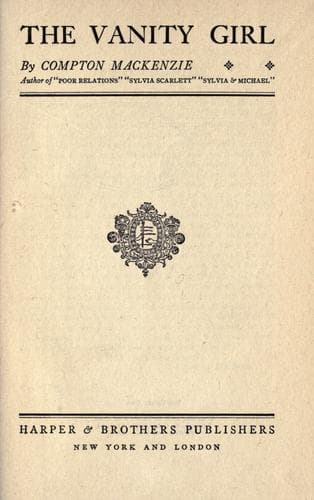
England -- Social life and customs -- 20th century -- Fiction; Social classes -- England -- Fiction
if during the months of expectation she kept close her secret and if it
were a boy, untrammeled by any obligations she should be at liberty to
make her own decision about his up-bringing. More and more she was
forming all her plans to fit the future of a boy, and one of her chief
reasons for not relying upon the good will of the family was her desire
to spare this son prenatal coddling by coddling herself.
Dorothy might have found it hard to analyze justly all the motives that
inspired her to take the step she did; but whatever they were, a hot
morning in late September found her sitting at the window of her old
room in Lonsdale Road.
II
If outwardly Lonsdale Road presented the same appearance as it had
presented on that September morning twelve years ago when Dorothy, after
washing her hair, made up her mind to be engaged to Wilfred Curlew, the
standpoint from which she now looked out of her window was so profoundly
changed that the road itself was transmuted by the alchemy of her mind
to achieve the significant and incommunicable landscape of a dream. It
was as if in looking at Lonsdale Road she were looking at herself, and a
much truer self than she ever used to see portrayed in that old mirror
upon her dressing-table.
In an upper room of the house opposite a servant was dusting. Down
below, amid that immemorial acrid smell of privet, two little girls were
busily digging in the front garden. These were the daughters of her
second sister, the rightful Dorothy, who was staying with her parents
because her husband, Claude Savage, had left Norbiton for France with
his regiment of territorials. Mrs. Savage, a dark, neat little woman, as
capable a housewife as she had promised to become, and at twenty-eight
not quite so annoying as formerly, came into the room from time to time
and glanced out of the window to see that her little girls were not
making themselves too dirty.
"Hope they're not disturbing you with their chattering."
"No, no," said the countess. "I like listening to them."
Ah, there was Edna down below, not as twelve years ago giggling back
from school with Agnes, but wheeling a perambulator and from time to
time bending cautiously over to arrange the coverlet over her sleeping
baby. Edna was a dull edition of Agnes, and already at twenty-six much
more like Mrs. Caffyn than any of her sisters. Her chin was rather
furry; she was indefinite, not so indefinite as her mother because
modern education had not permitted to her what was formerly considered a
prerogative of woman. Edna had been married for about three years to
Walter Hume, a young doctor in Golders Green, who was stationed at some
northern camp with the R.A.M.C. She, too, was staying with her
parents.
"Edna keeps on fussing with the coverlet," said Mrs. Savage, critically.
"But she ought not to be walking along the sunny side of the pavement."
Public-domain text, read in full here on John Shaqi.
Reviews
Reviews
No reviews yet
Be the first to share your thoughts on this work.
Elsewhere in the archive
Join the Discussion
Join the discussion
Sign in to leave a comment or review.
Sign InorCreate an account