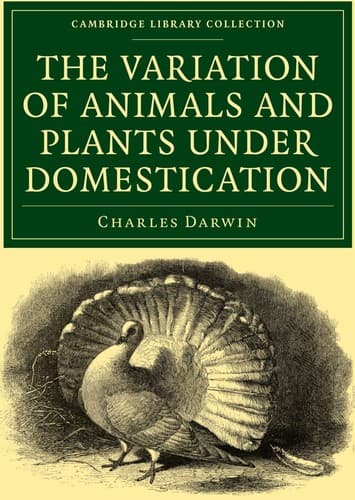
We now come to the best known rock-pigeon, the _Columba livia,_
which is often designated in Europe pre-eminently as the
Rock-pigeon, and which naturalists believe to be the parent of all
the domesticated breeds. This bird agrees in every essential
character with the breeds which have been only slightly modified.
It differs from all other species in being of a slaty-blue colour,
with two black bars on the wings, and with the croup (or loins)
white. Occasionally birds are seen in Faroe and the Hebrides with
the black bars replaced by two or three black spots; this form has
been named by Brehm[9] _C. amaliæ,_ but this species has not been
admitted as distinct by other ornithologists. Graba[10] even found
a difference in the bars on the right and left wings of the same
bird in Faroe. Another and rather more distinct form is either
truly wild or has become feral on the cliffs of England and was
doubtfully named by Mr. Blyth[11] as _C. affinis,_ but is now no
longer considered by him as a distinct species. _C. affinis_ is
rather smaller than the rock-pigeon of the Scottish islands, and
has a very different appearance owing to the wing-coverts being
chequered with black, with similar marks often extending over the
back. The chequering consists of a large black spot on the two
sides, but chiefly on the outer side, of each feather. The
wing-bars in the true rock-pigeon and in the chequered variety are,
in fact, due to similar though larger spots symmetrically crossing
the secondary wing-feather and the larger coverts. Hence the
chequering arises merely from an extension of these marks to other
parts of the plumage. Chequered birds are not confined to the
coasts of England; for they were found by Graba at Faroe; and W.
Thompson[12] says that at Islay fully half the wild rock-pigeons
were chequered. Colonel King, of Hythe, stocked his dovecot with
young wild birds which he himself procured from nests at the Orkney
Islands; and several specimens, kindly sent to me by him, were all
plainly chequered. As we thus see that chequered birds occur
mingled with the true rock-pigeon at three distinct sites, namely,
Faroe, the Orkney Islands, and Islay, no importance can be attached
to this natural variation in the plumage.
Public-domain text, read in full here on John Shaqi.
Reviews
Reviews
No reviews yet
Be the first to share your thoughts on this work.
Elsewhere in the archive
Join the Discussion
Join the discussion
Sign in to leave a comment or review.
Sign InorCreate an account