species formerly existed, which differed greatly from each other in
some few points, but which resembled each other as closely as do the
domestic races in other points of structure, in voice, and in all their
habits of life. When these several facts and arguments are fairly taken
into consideration, it would require an overwhelming amount of evidence
to make us admit that the chief domestic races are descended from
several aboriginal stocks; and of such evidence there is absolutely
none.
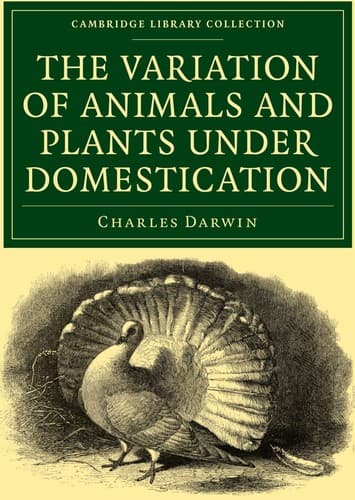
The belief that the chief domestic races are descended from several
wild stocks no doubt has arisen from the apparent improbability of such
great modifications of structure having been effected since man first
domesticated the rock-pigeon. Nor am I surprised at any degree of
hesitation in admitting their common parentage: formerly, when I went
into my aviaries and watched such birds as Pouters, Carriers, Barbs,
Fantails, and Short-faced Tumblers, etc., I could not persuade myself
that all had descended from the same wild stock, and that man had
consequently in one sense created these remarkable modifications.
Therefore I have argued the question of their origin at great, and, as
some will think, superfluous length.
Finally, in favour of the belief that all the races are descended
from a single stock, we have in _Columba livia_ a still existing
and widely distributed species, which can be and has been
domesticated in various countries. This species agrees in most
points of structure and in all its habits of life, as well as
occasionally in every detail of plumage, with the several domestic
races. It breeds freely with them, and produces fertile offspring.
It varies in a state of nature,[30] and still more so when
semi-domesticated, as shown by comparing the Sierra Leone pigeons
with those of India, or with those which apparently have run wild
in Madeira. It has undergone a still greater amount of variation in
the case of the numerous toy-pigeons, which no one supposes to be
descended from distinct species; yet some of these toy-pigeons have
transmitted their character truly for centuries. Why, then, should
we hesitate to believe in that greater amount of variation which is
necessary for the production of the eleven chief races? It should
be borne in mind that in two of the most strongly-marked races,
namely, Carriers and Short-faced Tumblers, the extreme forms can be
connected with the parent-species by graduated differences not
greater than those which may be observed between the
dovecot-pigeons inhabiting different countries, or between the
various kinds of toy-pigeons,—gradations which must certainly be
attributed to variation.
Public-domain text, read in full here on John Shaqi.
Reviews
Reviews
No reviews yet
Be the first to share your thoughts on this work.
Elsewhere in the archive
Join the Discussion
Join the discussion
Sign in to leave a comment or review.
Sign InorCreate an account