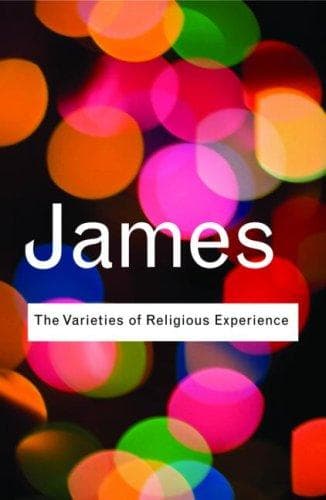
The Varieties of Religious Experience: A Study in Human NatureJames, William
ReligionComparative
The Varieties of Religious Experience: A Study in Human Nature
James, William
Conversion; Experience (Religion); Philosophy and religion; Psychology, Religious; Religion
The expression “field of consciousness” has but recently come into vogue
in the psychology books. Until quite lately the unit of mental life which
figured most was the single “idea” supposed to be a definitely outlined
thing. But at present psychologists are tending, first, to admit that the
actual unit is more probably the total mental state, the entire wave of
consciousness or field of objects present to the thought at any time; and,
second, to see that it is impossible to outline this wave, this field,
with any definiteness.
As our mental fields succeed one another, each has its centre of interest,
around which the objects of which we are less and less attentively
conscious fade to a margin so faint that its limits are unassignable. Some
fields are narrow fields and some are wide fields. Usually when we have a
wide field we rejoice, for we then see masses of truth together, and often
get glimpses of relations which we divine rather than see, for they shoot
beyond the field into still remoter regions of objectivity, regions which
we seem rather to be about to perceive than to perceive actually. At other
times, of drowsiness, illness, or fatigue, our fields may narrow almost to
a point, and we find ourselves correspondingly oppressed and contracted.
Different individuals present constitutional differences in this matter of
width of field. Your great organizing geniuses are men with habitually
vast fields of mental vision, in which a whole programme of future
operations will appear dotted out at once, the rays shooting far ahead
into definite directions of advance. In common people there is never this
magnificent inclusive view of a topic. They stumble along, feeling their
way, as it were, from point to point, and often stop entirely. In certain
diseased conditions consciousness is a mere spark, without memory of the
past or thought of the future, and with the present narrowed down to some
one simple emotion or sensation of the body.
The important fact which this “field” formula commemorates is the
indetermination of the margin. Inattentively realized as is the matter
which the margin contains, it is nevertheless there, and helps both to
guide our behavior and to determine the next movement of our attention. It
lies around us like a “magnetic field,” inside of which our centre of
energy turns like a compass‐needle, as the present phase of consciousness
alters into its successor. Our whole past store of memories floats beyond
this margin, ready at a touch to come in; and the entire mass of residual
powers, impulses, and knowledges that constitute our empirical self
stretches continuously beyond it. So vaguely drawn are the outlines
between what is actual and what is only potential at any moment of our
conscious life, that it is always hard to say of certain mental elements
whether we are conscious of them or not.
Public-domain text, read in full here on John Shaqi.
Reviews
Reviews
No reviews yet
Be the first to share your thoughts on this work.
Elsewhere in the archive
Join the Discussion
Join the discussion
Sign in to leave a comment or review.
Sign InorCreate an account