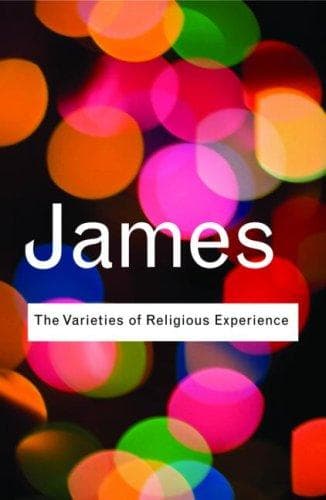
The Varieties of Religious Experience: A Study in Human NatureJames, William
ReligionComparative
The Varieties of Religious Experience: A Study in Human Nature
James, William
Conversion; Experience (Religion); Philosophy and religion; Psychology, Religious; Religion
“How long I continued in this state, with this baptism continuing
to roll over me and go through me, I do not know. But I know it
was late in the evening when a member of my choir—for I was the
leader of the choir—came into the office to see me. He was a
member of the church. He found me in this state of loud weeping,
and said to me, ‘Mr. Finney, what ails you?’ I could make him no
answer for some time. He then said, ‘Are you in pain?’ I gathered
myself up as best I could, and replied, ‘No, but so happy that I
cannot live.’ ”
I just now quoted Billy Bray; I cannot do better than give his own brief
account of his post‐conversion feelings:—
“I can’t help praising the Lord. As I go along the street, I lift
up one foot, and it seems to say ‘Glory’; and I lift up the other,
and it seems to say ‘Amen’; and so they keep up like that all the
time I am walking.”(140)
One word, before I close this lecture, on the question of the transiency
or permanence of these abrupt conversions. Some of you, I feel sure,
knowing that numerous backslidings and relapses take place, make of these
their apperceiving mass for interpreting the whole subject, and dismiss it
with a pitying smile at so much “hysterics.” Psychologically, as well as
religiously, however, this is shallow. It misses the point of serious
interest, which is not so much the duration as the nature and quality of
these shiftings of character to higher levels. Men lapse from every
level—we need no statistics to tell us that. Love is, for instance, well
known not to be irrevocable, yet, constant or inconstant, it reveals new
flights and reaches of ideality while it lasts. These revelations form its
significance to men and women, whatever be its duration. So with the
conversion experience: that it should for even a short time show a human
being what the high‐water mark of his spiritual capacity is, this is what
constitutes its importance,—an importance which backsliding cannot
diminish, although persistence might increase it. As a matter of fact, all
the more striking instances of conversion, all those, for instance, which
I have quoted, _have_ been permanent. The case of which there might be
most doubt, on account of its suggesting so strongly an epileptoid
seizure, was the case of M. Ratisbonne. Yet I am informed that
Ratisbonne’s whole future was shaped by those few minutes. He gave up his
project of marriage, became a priest, founded at Jerusalem, where he went
to dwell, a mission of nuns for the conversion of the Jews, showed no
tendency to use for egotistic purposes the notoriety given him by the
peculiar circumstances of his conversion,—which, for the rest, he could
seldom refer to without tears,—and in short remained an exemplary son of
the Church until he died, late in the 80’s, if I remember rightly.
Public-domain text, read in full here on John Shaqi.
Reviews
Reviews
No reviews yet
Be the first to share your thoughts on this work.
Elsewhere in the archive
Join the Discussion
Join the discussion
Sign in to leave a comment or review.
Sign InorCreate an account