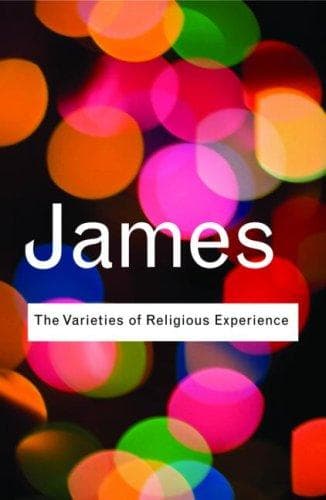
The Varieties of Religious Experience: A Study in Human NatureJames, William
ReligionComparative
The Varieties of Religious Experience: A Study in Human Nature
James, William
Conversion; Experience (Religion); Philosophy and religion; Psychology, Religious; Religion
Where to seek the easy and the pleasant seems instinctive—and instinctive
it appears to be in man; any deliberate tendency to pursue the hard and
painful as such and for their own sakes might well strike one as purely
abnormal. Nevertheless, in moderate degrees it is natural and even usual
to human nature to court the arduous. It is only the extreme
manifestations of the tendency that can be regarded as a paradox.
The psychological reasons for this lie near the surface. When we drop
abstractions and take what we call our will in the act, we see that it is
a very complex function. It involves both stimulations and inhibitions; it
follows generalized habits; it is escorted by reflective criticisms; and
it leaves a good or a bad taste of itself behind, according to the manner
of the performance. The result is that, quite apart from the immediate
pleasure which any sensible experience may give us, our own general moral
attitude in procuring or undergoing the experience brings with it a
secondary satisfaction or distaste. Some men and women, indeed, there are
who can live on smiles and the word “yes” forever. But for others (indeed
for most), this is too tepid and relaxed a moral climate. Passive
happiness is slack and insipid, and soon grows mawkish and intolerable.
Some austerity and wintry negativity, some roughness, danger, stringency,
and effort, some “no! no!” must be mixed in, to produce the sense of an
existence with character and texture and power. The range of individual
differences in this respect is enormous; but whatever the mixture of yeses
and noes may be, the person is infallibly aware when he has struck it in
the right proportion _for him_. This, he feels, is my proper vocation,
this is the _optimum_, the law, the life for me to live. Here I find the
degree of equilibrium, safety, calm, and leisure which I need, or here I
find the challenge, passion, fight, and hardship without which my soul’s
energy expires.
Every individual soul, in short, like every individual machine or
organism, has its own best conditions of efficiency. A given machine will
run best under a certain steam‐pressure, a certain amperage; an organism
under a certain diet, weight, or exercise. You seem to do best, I heard a
doctor say to a patient, at about 140 millimeters of arterial tension. And
it is just so with our sundry souls: some are happiest in calm weather;
some need the sense of tension, of strong volition, to make them feel
alive and well. For these latter souls, whatever is gained from day to day
must be paid for by sacrifice and inhibition, or else it comes too cheap
and has no zest.
Now when characters of this latter sort become religious, they are apt to
turn the edge of their need of effort and negativity against their natural
self; and the ascetic life gets evolved as a consequence.
Public-domain text, read in full here on John Shaqi.
Reviews
Reviews
No reviews yet
Be the first to share your thoughts on this work.
Elsewhere in the archive
Join the Discussion
Join the discussion
Sign in to leave a comment or review.
Sign InorCreate an account