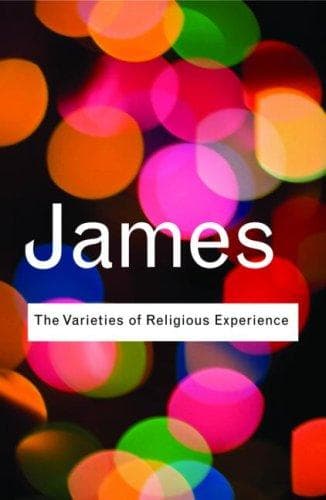
The Varieties of Religious Experience: A Study in Human NatureJames, William
ReligionComparative
The Varieties of Religious Experience: A Study in Human Nature
James, William
Conversion; Experience (Religion); Philosophy and religion; Psychology, Religious; Religion
“You must undo the wrappings, not case yourself in fresh ones;
“Not by multiplying clothes shall you make your body sound and
healthy, but rather by discarding them ...
“For a soldier who is going on a campaign does not seek what fresh
furniture he can carry on his back, but rather what he can leave
behind;
“Knowing well that every additional thing which he cannot freely
use and handle is an impediment.”(193)
In short, lives based on having are less free than lives based either on
doing or on being, and in the interest of action people subject to
spiritual excitement throw away possessions as so many clogs. Only those
who have no private interests can follow an ideal straight away. Sloth and
cowardice creep in with every dollar or guinea we have to guard. When a
brother novice came to Saint Francis, saying: “Father, it would be a great
consolation to me to own a psalter, but even supposing that our general
should concede to me this indulgence, still I should like also to have
your consent,” Francis put him off with the examples of Charlemagne,
Roland, and Oliver, pursuing the infidels in sweat and labor, and finally
dying on the field of battle. “So care not,” he said, “for owning books
and knowledge, but care rather for works of goodness.” And when some weeks
later the novice came again to talk of his craving for the psalter,
Francis said: “After you have got your psalter you will crave a breviary;
and after you have got your breviary you will sit in your stall like a
grand prelate, and will say to your brother: ‘Hand me my breviary.’ ...
And thenceforward he denied all such requests, saying: ‘A man possesses of
learning only so much as comes out of him in action, and a monk is a good
preacher only so far as his deeds proclaim him such, for every tree is
known by its fruits.’ ”(194)
Public-domain text, read in full here on John Shaqi.
Reviews
Reviews
No reviews yet
Be the first to share your thoughts on this work.
Elsewhere in the archive
Join the Discussion
Join the discussion
Sign in to leave a comment or review.
Sign InorCreate an account