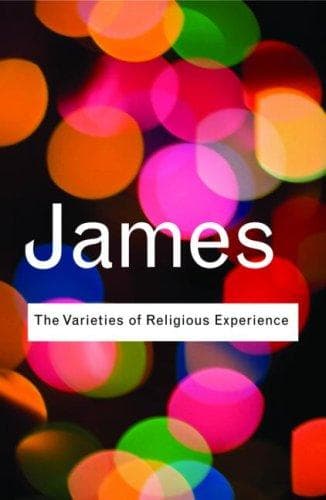
The Varieties of Religious Experience: A Study in Human NatureJames, William
ReligionComparative
The Varieties of Religious Experience: A Study in Human Nature
James, William
Conversion; Experience (Religion); Philosophy and religion; Psychology, Religious; Religion
“I had spent the evening in a great city, with two friends,
reading and discussing poetry and philosophy. We parted at
midnight. I had a long drive in a hansom to my lodging. My mind,
deeply under the influence of the ideas, images, and emotions
called up by the reading and talk, was calm and peaceful. I was in
a state of quiet, almost passive enjoyment, not actually thinking,
but letting ideas, images, and emotions flow of themselves, as it
were, through my mind. All at once, without warning of any kind, I
found myself wrapped in a flame‐colored cloud. For an instant I
thought of fire, an immense conflagration somewhere close by in
that great city; the next, I knew that the fire was within myself.
Directly afterward there came upon me a sense of exultation, of
immense joyousness accompanied or immediately followed by an
intellectual illumination impossible to describe. Among other
things, I did not merely come to believe, but I saw that the
universe is not composed of dead matter, but is, on the contrary,
a living Presence; I became conscious in myself of eternal life.
It was not a conviction that I would have eternal life, but a
consciousness that I possessed eternal life then; I saw that all
men are immortal; that the cosmic order is such that without any
peradventure all things work together for the good of each and
all; that the foundation principle of the world, of all the
worlds, is what we call love, and that the happiness of each and
all is in the long run absolutely certain. The vision lasted a few
seconds and was gone; but the memory of it and the sense of the
reality of what it taught has remained during the quarter of a
century which has since elapsed. I knew that what the vision
showed was true. I had attained to a point of view from which I
saw that it must be true. That view, that conviction, I may say
that consciousness, has never, even during periods of the deepest
depression, been lost.”(242)
We have now seen enough of this cosmic or mystic consciousness, as it
comes sporadically. We must next pass to its methodical cultivation as an
element of the religious life. Hindus, Buddhists, Mohammedans, and
Christians all have cultivated it methodically.
In India, training in mystical insight has been known from time immemorial
under the name of yoga. Yoga means the experimental union of the
individual with the divine. It is based on persevering exercise; and the
diet, posture, breathing, intellectual concentration, and moral discipline
vary slightly in the different systems which teach it. The yogi, or
disciple, who has by these means overcome the obscurations of his lower
nature sufficiently, enters into the condition termed _samâdhi_, “and
comes face to face with facts which no instinct or reason can ever know.”
He learns—
Public-domain text, read in full here on John Shaqi.
Reviews
Reviews
No reviews yet
Be the first to share your thoughts on this work.
Elsewhere in the archive
Join the Discussion
Join the discussion
Sign in to leave a comment or review.
Sign InorCreate an account