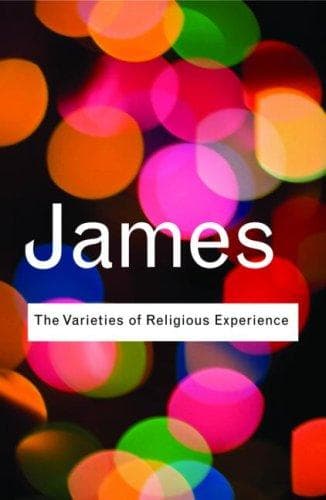
The Varieties of Religious Experience: A Study in Human NatureJames, William
ReligionComparative
The Varieties of Religious Experience: A Study in Human Nature
James, William
Conversion; Experience (Religion); Philosophy and religion; Psychology, Religious; Religion
Then Achilles savagely severs the poor boy’s neck with his sword, heaves
him by the foot into the Scamander, and calls to the fishes of the river
to eat the white fat of Lycaon. Just as here the cruelty and the sympathy
each ring true, and do not mix or interfere with one another, so did the
Greeks and Romans keep all their sadnesses and gladnesses unmingled and
entire. Instinctive good they did not reckon sin; nor had they any such
desire to save the credit of the universe as to make them insist, as so
many of _us_ insist, that what immediately appears as evil must be “good
in the making,” or something equally ingenious. Good was good, and bad
just bad, for the earlier Greeks. They neither denied the ills of
nature,—Walt Whitman’s verse, “What is called good is perfect and what is
called bad is just as perfect,” would have been mere silliness to
them,—nor did they, in order to escape from those ills, invent “another
and a better world” of the imagination, in which, along with the ills, the
innocent goods of sense would also find no place. This integrity of the
instinctive reactions, this freedom from all moral sophistry and strain,
gives a pathetic dignity to ancient pagan feeling. And this quality
Whitman’s outpourings have not got. His optimism is too voluntary and
defiant; his gospel has a touch of bravado and an affected twist,(42) and
this diminishes its effect on many readers who yet are well disposed
towards optimism, and on the whole quite willing to admit that in
important respects Whitman is of the genuine lineage of the prophets.
‐‐‐‐‐‐‐‐‐‐‐‐‐‐‐‐‐‐‐‐‐‐‐‐‐‐‐‐‐‐‐‐‐‐‐‐‐
If, then, we give the name of healthy‐mindedness to the tendency which
looks on all things and sees that they are good, we find that we must
distinguish between a more involuntary and a more voluntary or systematic
way of being healthy‐minded. In its involuntary variety, healthy‐
mindedness is a way of feeling happy about things immediately. In its
systematical variety, it is an abstract way of conceiving things as good.
Every abstract way of conceiving things selects some one aspect of them as
their essence for the time being, and disregards the other aspects.
Systematic healthy‐mindedness, conceiving good as the essential and
universal aspect of being, deliberately excludes evil from its field of
vision; and although, when thus nakedly stated, this might seem a
difficult feat to perform for one who is intellectually sincere with
himself and honest about facts, a little reflection shows that the
situation is too complex to lie open to so simple a criticism.
Public-domain text, read in full here on John Shaqi.
Reviews
Reviews
No reviews yet
Be the first to share your thoughts on this work.
Elsewhere in the archive
Join the Discussion
Join the discussion
Sign in to leave a comment or review.
Sign InorCreate an account