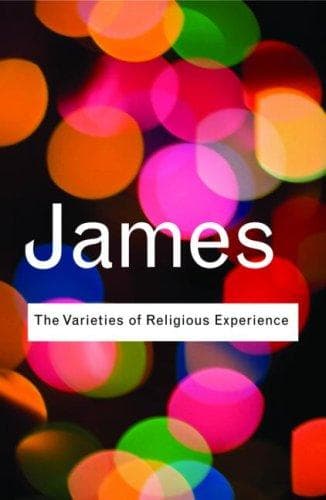
The Varieties of Religious Experience: A Study in Human NatureJames, William
ReligionComparative
The Varieties of Religious Experience: A Study in Human Nature
James, William
Conversion; Experience (Religion); Philosophy and religion; Psychology, Religious; Religion
In all this I say nothing of any mystical insight or persuasion that the
total frame of things absolutely must be good. Such mystical persuasion
plays an enormous part in the history of the religious consciousness, and
we must look at it later with some care. But we need not go so far at
present. More ordinary non‐mystical conditions of rapture suffice for my
immediate contention. All invasive moral states and passionate enthusiasms
make one feelingless to evil in some direction. The common penalties cease
to deter the patriot, the usual prudences are flung by the lover to the
winds. When the passion is extreme, suffering may actually be gloried in,
provided it be for the ideal cause, death may lose its sting, the grave
its victory. In these states, the ordinary contrast of good and ill seems
to be swallowed up in a higher denomination, an omnipotent excitement
which engulfs the evil, and which the human being welcomes as the crowning
experience of his life. This, he says, is truly to live, and I exult in
the heroic opportunity and adventure.
The systematic cultivation of healthy‐mindedness as a religious attitude
is therefore consonant with important currents in human nature, and is
anything but absurd. In fact, we all do cultivate it more or less, even
when our professed theology should in consistency forbid it. We divert our
attention from disease and death as much as we can; and the slaughter‐
houses and indecencies without end on which our life is founded are
huddled out of sight and never mentioned, so that the world we recognize
officially in literature and in society is a poetic fiction far handsomer
and cleaner and better than the world that really is.(43)
The advance of liberalism, so‐called, in Christianity, during the past
fifty years, may fairly be called a victory of healthy‐mindedness within
the church over the morbidness with which the old hell‐fire theology was
more harmoniously related. We have now whole congregations whose
preachers, far from magnifying our consciousness of sin, seem devoted
rather to making little of it. They ignore, or even deny, eternal
punishment, and insist on the dignity rather than on the depravity of man.
They look at the continual preoccupation of the old‐fashioned Christian
with the salvation of his soul as something sickly and reprehensible
rather than admirable; and a sanguine and “muscular” attitude, which to
our forefathers would have seemed purely heathen, has become in their eyes
an ideal element of Christian character. I am not asking whether or not
they are right, I am only pointing out the change.
Public-domain text, read in full here on John Shaqi.
Reviews
Reviews
No reviews yet
Be the first to share your thoughts on this work.
Elsewhere in the archive
Join the Discussion
Join the discussion
Sign in to leave a comment or review.
Sign InorCreate an account