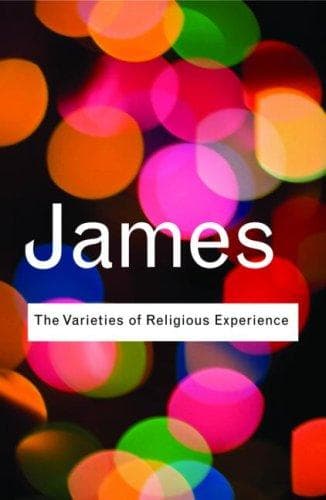
The Varieties of Religious Experience: A Study in Human NatureJames, William
ReligionComparative
The Varieties of Religious Experience: A Study in Human Nature
James, William
Conversion; Experience (Religion); Philosophy and religion; Psychology, Religious; Religion
“I think that the one thing which impressed me most was learning
the fact that we must be in absolutely constant relation or mental
touch (this word is to me very expressive) with that essence of
life which permeates all and which we call God. This is almost
unrecognizable unless we live it into ourselves _actually_, that
is, by a constant turning to the very innermost, deepest
consciousness of our real selves or of God in us, for illumination
from within, just as we turn to the sun for light, warmth, and
invigoration without. When you do this consciously, realizing that
to turn inward to the light within you is to live in the presence
of God or your divine self, you soon discover the unreality of the
objects to which you have hitherto been turning and which have
engrossed you without.
“I have come to disregard the meaning of this attitude for bodily
health _as such_, because that comes of itself, as an incidental
result, and cannot be found by any special mental act or desire to
have it, beyond that general attitude of mind I have referred to
above. That which we usually make the object of life, those outer
things we are all so wildly seeking, which we so often live and
die for, but which then do not give us peace and happiness, they
should all come of themselves as accessory, and as the mere
outcome or natural result of a far higher life sunk deep in the
bosom of the spirit. This life is the real seeking of the kingdom
of God, the desire for his supremacy in our hearts, so that all
else comes as that which shall be ‘added unto you’—as quite
incidental and as a surprise to us, perhaps; and yet it is the
proof of the reality of the perfect poise in the very centre of
our being.
“When I say that we commonly make the object of our life that
which we should not work for primarily, I mean many things which
the world considers praiseworthy and excellent, such as success in
business, fame as author or artist, physician or lawyer, or renown
in philanthropic undertakings. Such things should be results, not
objects. I would also include pleasures of many kinds which seem
harmless and good at the time, and are pursued because many accept
them—I mean conventionalities, sociabilities, and fashions in
their various development, these being mostly approved by the
masses, although they may be unreal, and even unhealthy
superfluities.”
Here is another case, more concrete, also that of a woman. I read you
these cases without comment,—they express so many varieties of the state
of mind we are studying.
Public-domain text, read in full here on John Shaqi.
Reviews
Reviews
No reviews yet
Be the first to share your thoughts on this work.
Elsewhere in the archive
Join the Discussion
Join the discussion
Sign in to leave a comment or review.
Sign InorCreate an account