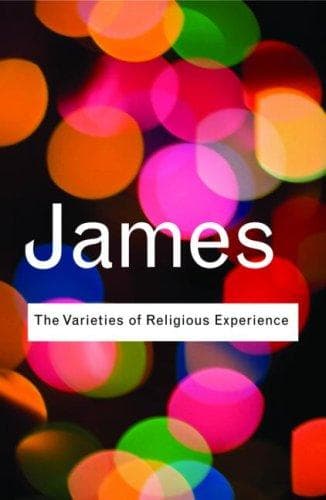
The Varieties of Religious Experience: A Study in Human NatureJames, William
ReligionComparative
The Varieties of Religious Experience: A Study in Human Nature
James, William
Conversion; Experience (Religion); Philosophy and religion; Psychology, Religious; Religion
If we admit that evil is an essential part of our being and the key to the
interpretation of our life, we load ourselves down with a difficulty that
has always proved burdensome in philosophies of religion. Theism, whenever
it has erected itself into a systematic philosophy of the universe, has
shown a reluctance to let God be anything less than All‐in‐All. In other
words, philosophic theism has always shown a tendency to become
pantheistic and monistic, and to consider the world as one unit of
absolute fact; and this has been at variance with popular or practical
theism, which latter has ever been more or less frankly pluralistic, not
to say polytheistic, and shown itself perfectly well satisfied with a
universe composed of many original principles, provided we be only allowed
to believe that the divine principle remains supreme, and that the others
are subordinate. In this latter case God is not necessarily responsible
for the existence of evil; he would only be responsible if it were not
finally overcome. But on the monistic or pantheistic view, evil, like
everything else, must have its foundation in God; and the difficulty is to
see how this can possibly be the case if God be absolutely good. This
difficulty faces us in every form of philosophy in which the world appears
as one flawless unit of fact. Such a unit is an _Individual_, and in it
the worst parts must be as essential as the best, must be as necessary to
make the individual what he is; since if any part whatever in an
individual were to vanish or alter, it would no longer be _that_
individual at all. The philosophy of absolute idealism, so vigorously
represented both in Scotland and America to‐day, has to struggle with this
difficulty quite as much as scholastic theism struggled in its time; and
although it would be premature to say that there is no speculative issue
whatever from the puzzle, it is perfectly fair to say that there is no
clear or easy issue, and that the only _obvious_ escape from paradox here
is to cut loose from the monistic assumption altogether, and to allow the
world to have existed from its origin in pluralistic form, as an aggregate
or collection of higher and lower things and principles, rather than an
absolutely unitary fact. For then evil would not need to be essential; it
might be, and may always have been, an independent portion that had no
rational or absolute right to live with the rest, and which we might
conceivably hope to see got rid of at last.
Public-domain text, read in full here on John Shaqi.
Reviews
Reviews
No reviews yet
Be the first to share your thoughts on this work.
Elsewhere in the archive
Join the Discussion
Join the discussion
Sign in to leave a comment or review.
Sign InorCreate an account