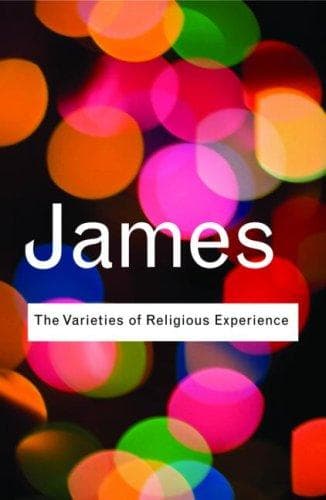
The Varieties of Religious Experience: A Study in Human NatureJames, William
ReligionComparative
The Varieties of Religious Experience: A Study in Human Nature
James, William
Conversion; Experience (Religion); Philosophy and religion; Psychology, Religious; Religion
Let us now say good‐by for a while to all this way of thinking, and turn
towards those persons who cannot so swiftly throw off the burden of the
consciousness of evil, but are congenitally fated to suffer from its
presence. Just as we saw that in healthy‐mindedness there are shallower
and profounder levels, happiness like that of the mere animal, and more
regenerate sorts of happiness, so also are there different levels of the
morbid mind, and the one is much more formidable than the other. There are
people for whom evil means only a mal‐adjustment with _things_, a wrong
correspondence of one’s life with the environment. Such evil as this is
curable, in principle at least, upon the natural plane, for merely by
modifying either the self or the things, or both at once, the two terms
may be made to fit, and all go merry as a marriage bell again. But there
are others for whom evil is no mere relation of the subject to particular
outer things, but something more radical and general, a wrongness or vice
in his essential nature, which no alteration of the environment, or any
superficial rearrangement of the inner self, can cure, and which requires
a supernatural remedy. On the whole, the Latin races have leaned more
towards the former way of looking upon evil, as made up of ills and sins
in the plural, removable in detail; while the Germanic races have tended
rather to think of Sin in the singular, and with a capital S, as of
something ineradicably ingrained in our natural subjectivity, and never to
be removed by any superficial piecemeal operations.(70) These comparisons
of races are always open to exception, but undoubtedly the northern tone
in religion has inclined to the more intimately pessimistic persuasion,
and this way of feeling, being the more extreme, we shall find by far the
more instructive for our study.
Public-domain text, read in full here on John Shaqi.
Reviews
Reviews
No reviews yet
Be the first to share your thoughts on this work.
Elsewhere in the archive
Join the Discussion
Join the discussion
Sign in to leave a comment or review.
Sign InorCreate an account