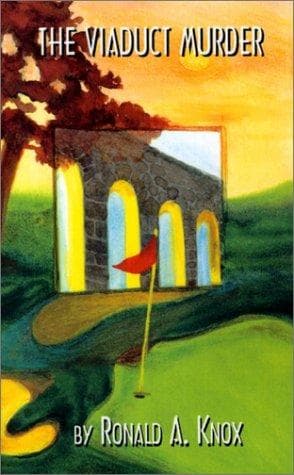
Detective and mystery stories; England -- Fiction; Murder -- Investigation -- Fiction
“But I don’t think I know any history much.”
“That doesn’t matter; it’s quite easy to read your stuff up if you
confine yourself to a particular period or a particular kind of
history. For the beginner, Church history may be confidently
recommended. Public interest in the subject is so small that it is
very unlikely any one will take the trouble to contradict you. If the
worst comes to the worst, you can always fall back upon literary
criticism, and there you are on perfectly safe ground. A man with a
documentary hypothesis can defy the rudest assaults of common sense.”
“How does one do that, exactly?”
“You have to start out by saying, ‘This document consists of three
parts. One part is genuine, one part is spurious, the third part is
faked evidence put in to make the spurious stuff look as if it was
genuine!’ Then, you see, you are on velvet. You reject altogether the
parts of the document which you don’t like. Then you take the
remaining part, and find that it still contains a certain sort of
dross—evidence which still conflicts with your theory. That dross you
purge away by calling it a deliberate fake. The watch says 4.54—that
is proof positive that, in the first place, the murder took place at
3.54, and, in the second place, the murderer tried to pretend it
didn’t. You see the idea? Now, the more of that business you do, the
more ingenious your theory becomes, and the more ingenious your theory
becomes, the more easily will people accept it as true. Half the
statements which we regard as facts in history and criticism are
statements made by critics, which are so ingenious that nobody has the
heart to doubt them. And so the silly old world goes on. What if our
forefathers are misjudged? We keep our mouths, not our ears, to the
metaphone, and the honourable gentlemen get no opportunity to reply:
and it doesn’t matter much to them, because, like sensible people,
they’ve dropped their end of the tube, and left us to talk into empty
air.”
“Do you know, Gordon, I believe you talk an awful lot of rot.”
“I know. But it isn’t all rot. Well, what are you proposing to do?”
“I am proposing to devote myself in future to the Game—the Game, the
whole Game, and nothing but the Game.”
Chapter XXV. The Dull Facts
The Dormy-house,
Paston Oatvile,
Binver
My dear Gordon,
Reeves has just been in to inform me that Davenant has been hung. A
laughable misconception, of course; he has not been hung, he has been
hanged.
Public-domain text, read in full here on John Shaqi.
Reviews
Reviews
No reviews yet
Be the first to share your thoughts on this work.
Elsewhere in the archive
Join the Discussion
Join the discussion
Sign in to leave a comment or review.
Sign InorCreate an account