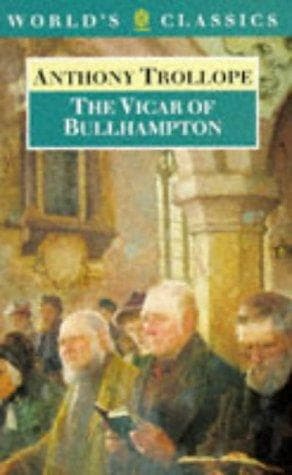
The Vicar of Bullhampton was--a "good sort of fellow." In praise of
him to this extent it is hoped that the reader will cordially agree.
But it cannot be denied that he was the most imprudent of men. He
had done very much that was imprudent in respect to the Marquis of
Trowbridge; and since he had been at Bullhampton had been imprudent
in nearly everything that he had done regarding the Brattles. He was
well aware that the bold words which he had spoken to the Marquis had
been dragon's teeth sown by himself, and that they had sprung up from
the ground in the shape of the odious brick building which now stood
immediately in face of his own Vicarage gate. Though he would smile
and be droll, and talk to the workmen, he hated that building quite
as bitterly as did his wife. And now, in regard to the Brattles,
there came upon him a great trouble. About a week after he had lent
the four pounds to Fanny on Sam's behalf, there came to him a dirty
note from Salisbury, written by Sam himself, in which he was told
that Carry Brattle was now at the Three Honest Men, a public-house in
one of the suburbs of the city, waiting there till Mr. Fenwick should
find a home for her,--in accordance with his promise given to her
brother. Sam, in his letter, had gone on to explain that it would be
well that Mr. Fenwick should visit the Three Honest Men speedily, as
otherwise there would be a bill there which neither Carry nor Sam
would be able to defray. Poor Sam's letter was bald, and they who did
not understand his position might have called it bold. He wrote to
the Vicar as though the Vicar's coming to Salisbury for the required
purpose was a matter of course; and demanded a home for his sister
without any reference to her future mode of life, or power of earning
her bread, as though it was the Vicar's manifest duty to provide such
home. And then that caution in regard to the bill was rather a threat
than anything else. If you don't take her quickly from the Three
Honest Men there'll be the very mischief of a bill for you to pay.
That was the meaning of the caution, and so the Vicar understood it.
Public-domain text, read in full here on John Shaqi.
Reviews
Reviews
No reviews yet
Be the first to share your thoughts on this work.
Elsewhere in the archive
Join the Discussion
Join the discussion
Sign in to leave a comment or review.
Sign InorCreate an account